
Chapter 4 · Limited Companies and Multinationals
Compare how private and public limited companies are owned, formed and financed, then explore what distinguishes multinational businesses.
Learning objectives
- Explain how limited companies are formed and why they have a separate legal identity and limited liability.
- Distinguish private and public limited companies and analyse their advantages and disadvantages.
- Understand company ownership, management, sources of finance and the use of profits.
- Describe the main features of multinational companies and recognise that businesses of the same ownership type can vary in size.
Features of Limited Companies
Unlike an unincorporated sole trader or ordinary partnership, a limited company has its own legal identity. It can hold property, sign contracts, employ staff, borrow money, and take or face legal action in its own name. The company's obligations belong to the company rather than automatically to the individual shareholders.
Ownership, control and responsibility
- Limited liability: if the business cannot repay its debts, shareholders normally stand to lose the capital they invested in its shares, not all their personal property. Limited liability does not mean a company itself has no responsibility to creditors.
- Shareholders: people or organisations that own shares. Share ownership can entitle them to vote on important issues, such as electing directors, and to receive dividends if these are declared.
- Board of directors: directors manage or oversee the company on behalf of its shareholders. The board is headed by a chairperson; directors are accountable to shareholders and may be voted out at a general meeting.
- Business finance and profits: selling shares can raise capital. A company pays corporation tax on taxable profits, and some after-tax profit may be distributed as dividends while the remainder is retained to support the business.
- Legal formation: because incorporation creates a separate legal organisation, the company must complete the required registration procedures.
Three investors each buy $10,000 worth of shares in a new company. If that company fails, each would normally risk their $10,000 investment, rather than being required personally to cover every remaining company debt. Personal guarantees or wrongdoing can create different obligations.
The opening case studies contrast a technology company funded through investors with a much larger motor manufacturer. Both illustrate how a limited company can have multiple owners and raise money through share ownership, despite major differences in business size.
Forming a Limited Company
In the textbook's UK-focused explanation, forming a limited company involves registering the organisation with the Registrar of Companies and submitting important formation documents. The book describes the memorandum of association and the articles of association.
| Document | Purpose in the textbook | Examples of information |
|---|---|---|
| Memorandum of association | Describes the company and its constitution. | Company name, registered office, nature of its activities and proposed share capital. |
| Articles of association | Sets out the company's internal rules. | Shareholder rights, appointment of directors, meetings and auditing arrangements. |
| Certificate of incorporation | Confirms that the company has been officially registered. | Evidence that it can operate as an incorporated business. |
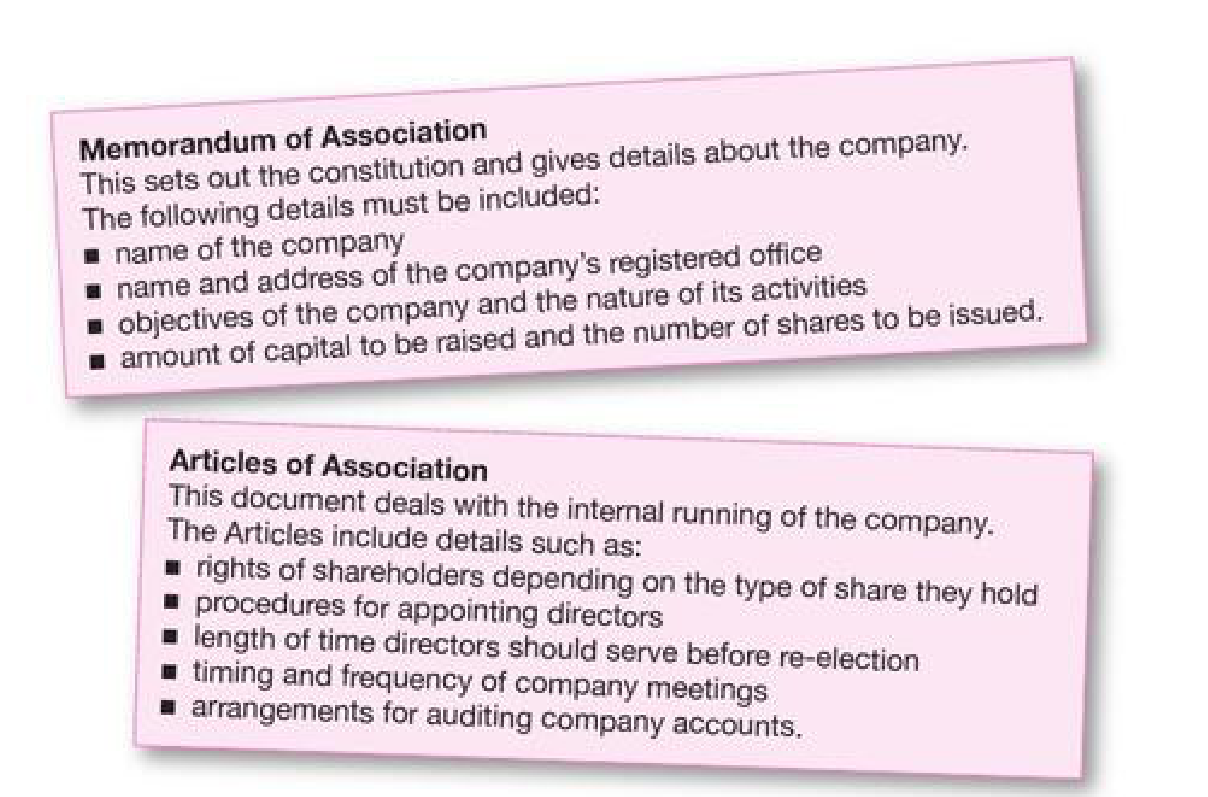
Once formation requirements are accepted, the business receives a certificate of incorporation. Shareholders may then exercise their rights, including taking part in the annual general meeting (AGM) according to the company's rules.
Investors in a new company want to know what shares they will own and who can appoint directors. The formation documents and internal rules help clarify these matters before disagreements arise.
The document descriptions above follow the textbook's explanation; actual registration requirements can differ by country and change over time.
Private Limited Companies
Most private limited companies are small or medium-sized, although some are very large. Many are owned by a family, a group of friends or selected investors. Directors often own shares as well as helping to manage the company.
- The name commonly ends in Limited or Ltd in the UK.
- Shares are transferred privately, usually subject to approval or restrictions; they are not openly traded on a stock exchange.
- Existing owners can therefore protect control, although limited access to investors can restrict the capital available for expansion.
Advantages and disadvantages of a private limited company
Advantages
- Shareholders benefit from limited liability.
- Can raise more finance than a sole owner might manage alone.
- Existing owners can usually keep control within a known group.
- The business can continue when an individual shareholder dies or leaves.
- May gain credibility with lenders, suppliers and customers.
Disadvantages
- Setting up and administering the company takes time and money.
- Financial information must be disclosed under applicable rules.
- Profits may need to be shared among shareholders.
- Share sales and transfers may take time.
- Cannot usually raise as much share capital as a public limited company.
The Pakistan-based sugar-mill case shows a family business operating as a private limited company while also having stakes held by outside investors and management. Being privately owned does not necessarily mean there is only one shareholder.
Check your understanding — halfway
Try these six questions before reading the remaining sections. Open each suggested answer only after attempting it.
What does it mean for a limited company to have a separate legal identity?
Show suggested answer
The company is a legal entity distinct from the shareholders. It can own assets, make contracts, employ people and be sued in its own name.
A shareholder buys 800 shares at $5 each. What is the value of the original investment, and what is normally at risk if the company fails?
Show suggested answer
The investment is 800 × $5 = $4,000. The shareholder would normally risk losing the $4,000 invested, rather than having to pay all the company’s debts personally.
Explain the difference between shareholders and directors in a limited company.
Show suggested answer
Shareholders own the company through shares and elect directors. Directors manage or oversee the business on behalf of shareholders; they are accountable to the shareholders.
Distinguish between the memorandum of association and the articles of association in the textbook.
Show suggested answer
The memorandum gives core details about the company and its constitution, while the articles describe how it is run internally, such as shareholder rights, directors and meetings.
Why might three relatives prefer a private limited company to a sole trader business?
Show suggested answer
They can pool money, share ownership and enjoy limited liability while keeping shares within a small group. But forming the company adds legal requirements, costs and disclosure obligations.
Why could the restrictions on selling shares in a private limited company be both an advantage and a disadvantage?
Show suggested answer
They help existing shareholders retain control by preventing easy sales to outsiders. However, they make shares harder to sell and can limit the amount of new capital the business can raise.
Public Limited Companies
Going public enables a business to invite a much wider range of investors to buy shares. The process of making shares available to the public is called flotation. A company may produce a prospectus to provide investors with information about the business and the share offer.
Costs and requirements of going public
The textbook uses a UK PLC as its example and states a minimum share capital requirement of £50,000. It also highlights several potential flotation expenses:
- Legal checks to ensure information in the prospectus is accurate and compliant.
- Preparing and distributing the prospectus and other paperwork.
- Fees to banks that organise applications and to underwriters, who may agree to buy unsold shares.
- Advertising, administration and ongoing reporting or regulatory compliance.
The £50,000 figure is presented as the book's UK PLC example; this is not a complete statement of all current listing or incorporation requirements.
Advantages and disadvantages of a public limited company
Advantages
- Potential to raise substantial amounts of share capital.
- Shareholders continue to have limited liability.
- Large-scale operations may achieve economies of scale.
- Shares are generally easier to buy and sell.
- Public visibility may strengthen the brand and help the company grow.
Disadvantages
- Flotation and ongoing compliance can be expensive.
- Outside investors may buy enough shares to gain influence or control.
- More financial information must be made public.
- Complex management structures may become less responsive to customers.
- Shareholders and hired managers may have different priorities.
Private vs public limited companies
| Feature | Private limited company | Public limited company |
|---|---|---|
| Shareholders' liability | Limited | Limited |
| Who can buy shares? | Selected or approved private investors | Shares can be offered to the public |
| Ability to raise very large share capital | Generally more restricted | Generally stronger, but with higher costs |
| Ownership control | Often remains within a family or close group | Can be dispersed among many investors |
| Information and regulation | Legal reporting requirements | Usually greater disclosure and market oversight |
A successful manufacturer needs substantial capital for two new overseas factories. Selling shares to the public could provide funds without borrowing all the money, but the current owners would need to consider the cost of flotation and possible loss of control.
Features of Multinationals
The textbook refers to companies such as Toyota, Microsoft, Coca-Cola and McDonald's to illustrate operations spanning national borders. Selling goods abroad alone is not necessarily enough: a multinational also operates a substantial part of its business in more than one country.
Typical features
- Extensive assets and turnover: large factories, equipment, buildings and financial resources allow major investment projects.
- Specialist management: experienced executives and professional managers coordinate operations across different markets.
- Powerful marketing: substantial advertising budgets help build and defend international brands.
- Advanced technology: investment in modern production and information systems can improve efficiency and reduce unit costs.
- Economic and political influence: a large employer or investor can affect regional economies and may influence government decisions.
- Economies of scale: buying and producing on a large scale can lower average costs, strengthening competitiveness.
- Centralised ownership and control: major strategic decisions are often made at the company's headquarters, even though it operates in several countries.
Sony is used as an example of an international business with manufacturing and sales across numerous countries. The textbook also shows a historical increase in its advertising spending, illustrating how multinationals can devote large sums to marketing.
Size brings opportunities but does not guarantee success. A multinational must still manage costs, competition, differences between countries and the complexity of coordinating operations far from headquarters.
Large vs Small Businesses
Not every company with limited liability is large. Many private limited companies are small family businesses, while others become substantial national or international firms. Likewise, a company can remain privately owned even when it is very large.
Public limited companies are often large because public share issues can provide significant finance. Multinationals are typically very large because operating in several countries requires major resources. However, company ownership type and business size are not the same thing.
This Hong Kong business is described as a private company considering how to raise approximately HK$200 million for expansion, including a distribution centre and new activities. It provides a useful decision: keep ownership private and seek alternative funding, or go public and accept greater costs and potential dilution of control?
| Business | Possible size | What to remember |
|---|---|---|
| Private limited company | Small, medium or large | Shares stay privately held; size does not alone make it public. |
| Public limited company | Usually medium or large | Wider access to share capital, with extra cost and disclosure. |
| Multinational | Typically large | Operates significantly in two or more countries, often with extensive assets. |
End-of-chapter understanding questions
Check knowledge, apply the ideas to businesses and practise reasoned judgements. Reveal a suggested answer only after attempting each question.
Define a limited company and explain two of its characteristics.
Show suggested answer
It is an incorporated business with a legal identity separate from its owners. Its shareholders normally have limited liability, and it raises share capital by issuing shares. Directors run the business, and the company follows legal formation rules.
Why is limited liability important to an investor considering a new business?
Show suggested answer
It generally caps the shareholder’s financial exposure at the amount invested. This encourages investment in ventures where profits are possible but business failure remains a risk.
A family-owned food manufacturer wants to expand without giving outsiders control. Assess whether remaining a private limited company is suitable.
Show suggested answer
A private limited company allows the family to retain control and enjoy limited liability, while perhaps bringing in selected investors. However, restricted share transfers and fewer potential buyers make raising very large sums difficult. Remaining private suits moderate expansion if internal funds, loans or a small group of investors are sufficient.
Describe the purpose of a prospectus when a business goes public.
Show suggested answer
A prospectus provides important information about the company and share offer to prospective investors, allowing them to assess the opportunity and risks. The textbook explains that producing and checking it is an important flotation expense.
Explain two advantages and two disadvantages of becoming a public limited company.
Show suggested answer
Advantages include the ability to raise large amounts of share capital and make shares more easily tradable. Disadvantages include significant flotation and compliance costs, public disclosure and the risk of losing control to new investors.
Compare the ability of private and public limited companies to raise capital.
Show suggested answer
Both can issue shares, but private companies sell them privately to an approved or limited group, whereas public limited companies can offer shares to the public. This can provide access to more investors and much larger sums, though at higher cost and with more regulation.
The textbook describes Khan Sugar Mills as a private limited company with several shareholders. Does having multiple investors automatically make a company public? Explain.
Show suggested answer
No. Private companies may have several shareholders, including outside investors, without their shares being offered freely on a stock exchange. Ownership structure and rules on selling shares matter more than the number of investors alone.
Give four typical features of a multinational company and explain one possible benefit from each.
Show suggested answer
Large assets support major projects; experienced managers can run operations across countries; substantial marketing budgets help build global brands; advanced technology can improve efficiency. Multinationals also often have strong economic and political influence.
Why might a multinational be able to compete more effectively with a small local manufacturer?
Show suggested answer
It may benefit from economies of scale, greater finance, advanced equipment, stronger advertising and access to specialised managers. A smaller business may nevertheless compete through personal service or local knowledge.
Kwok Hung Office Supplies wants to raise substantial finance to establish a distribution centre and expand overseas. Evaluate whether floating the company is a sensible option.
Show suggested answer
A flotation could raise substantial share capital to finance new facilities and expansion, and shareholders might benefit from a larger business. Against this are prospectus, legal and underwriting costs, increased disclosure and the possibility of losing ownership control. It is more suitable if the expected expansion benefits justify the cost and dilution of control.
Can a private limited company be large? Use a reason or example to support your answer.
Show suggested answer
Yes. Private limited companies can have substantial assets, employees and revenue while shares remain privately held. The textbook contrasts small family companies with large private businesses, showing that size and legal ownership type are not the same.
Chapter 4 recap
Limited companies have separate legal identities, share ownership and limited liability. Private limited companies retain privately controlled shares, while public limited companies can raise wider share capital through flotation but face more cost and disclosure. Multinationals operate significantly across countries and often have substantial resources. Business size and ownership type must be considered separately.
Based on Chapter 4, Limited Companies and Multinationals (printed pp. 27–34) of the user-supplied Pearson Edexcel International GCSE (9–1) Business Student Book by Rob Jones (Pearson). These revision notes, explanations, original comparison tables and questions are independently written; the memorandum/articles figure is credited above. Examples and figures taken from the textbook are historical, not current company reports. IGCSE360 is not affiliated with Pearson.