
Chapter 5 · Public Corporations
Discover why governments own some businesses, the arguments for and against state ownership, and how and why privatisation takes place.
Learning objectives
- Describe the key characteristics of public corporations, including their ownership, control, finance and use of profits.
- Explain reasons for public ownership and the drawbacks of government-run businesses.
- Describe different methods of privatisation.
- Analyse why a government might privatise a business and judge the likely effects on different stakeholders.
Features of Public Corporations
Public corporations supply services or goods that governments believe should be provided under public control. The book uses services such as water, transport and broadcasting to explain how public ownership works. They often have objectives other than maximising profit, although they still need to manage their finances responsibly.
| Textbook feature | What it means |
|---|---|
| State owned | The government owns the organisation and appoints people, often a board of directors, to manage it. The state determines the broad policy. |
| Created by law | Public corporations are established by legislation which sets out their powers and duties. |
| Incorporation | They have a separate legal identity and can own assets, enter contracts and be involved in legal action in their own names. |
| State funded | Government funds much of the capital, usually from taxation; corporations may also borrow and use revenue from providing services. |
| Provide public services | Meeting people’s needs and ensuring access are often more important than maximising profit. Some public corporations can make a profit. |
| Public accountability | Reports are submitted to the relevant government minister, and the corporation ultimately answers to the public and taxpayers. Profits may be reinvested or passed to the government. |
The textbook describes the National Water and Sewerage Corporation (NWSC) as a government-owned provider of water and sewerage services. Its focus on reliable water supply, service quality and customer satisfaction shows why the needs of users can be central to a public corporation’s objectives.
A public corporation belongs to the government. A public limited company (PLC), studied in Chapter 4, is owned by shareholders who can generally buy and sell its shares. The word public has different meanings in these two terms.
Reasons for the Public Ownership of Businesses
Governments may own businesses where leaving decisions entirely to private firms could make essential services too costly, unreliable or inaccessible. The textbook identifies five main reasons.
Avoid wasteful duplication
Some services are natural monopolies: one provider may supply the whole market more efficiently because the infrastructure is extremely expensive. Having several overlapping water-pipe systems, for example, can waste scarce resources. A single network may be less costly overall.
Maintain control of strategic industries
Energy and water supplies can be essential for national security and daily life. Government ownership may help ensure reliable supply, appropriate quality and continued access, while keeping critical infrastructure under national control.
Save jobs
A government may take a major employer into public ownership to prevent large job losses and the effects of unemployment on local communities. However, supporting jobs can impose a cost on taxpayers if a business continues to make losses.
Fill the gaps left by the private sector
Private businesses may provide too little of a socially important service because they cannot earn enough revenue. Education is one example in the textbook: the benefits to society are wider than the fees individual families are willing or able to pay.
Serve unprofitable regions
A remote rural area may have too few customers to make electricity, transport or water provision profitable. A public provider may still serve it because access is socially valuable even when revenues do not cover all costs.
Suppose serving 40 remote homes requires an expensive new power line. A private operator might reject the project because sales are too low. The government may fund the network to improve living standards and enable local businesses to operate.
Reasons Against the Public Ownership of Businesses
Supporters of private enterprise argue that public corporations can face weaker incentives to control costs and may be affected by political priorities. These are criticisms, rather than outcomes that occur in every public business.
| Drawback in the textbook | Explanation and possible consequence |
|---|---|
| Cost to government | Operating losses may need to be met through taxation or government borrowing. Subsidies can compete with other uses of public funds. |
| Inefficiency | Where there is little competition or profit pressure, a corporation may have less incentive to improve productivity, costs or service quality. |
| Political interference | Governments may change policies and targets, including prices or investment priorities, which can make long-term planning difficult. |
| Difficult to control | Very large organisations, with thousands of employees or operations across wide areas, can be hard to coordinate and manage effectively. |
The textbook uses SNCF, the French rail operator, to consider both the social aims of a publicly owned transport provider and the cost of losses. Its 2015 loss of €12.3 billion, as reported by the textbook, illustrates why public spending and accountability are important considerations. This is a historical example, not a statement about SNCF’s current finances.
Balanced judgement: A service that loses money can still benefit society, for example by helping people travel to work. Governments must consider both the cost to taxpayers and the wider value created.
Check your understanding · Halfway through
Try these questions before continuing to privatisation. Select Show suggested answer only after writing or saying your own answer.
What is a public corporation? Give two characteristics.
Show suggested answer
A public corporation is a business owned and controlled by the state. It is normally established under law and is run by appointed managers or directors on behalf of the government.
Explain the difference between state ownership and public accountability.
Show suggested answer
State ownership means the government owns the corporation. Public accountability means its actions and results must be reported and justified to ministers and ultimately taxpayers.
Why might a government prefer one publicly owned water network instead of several competing pipe networks?
Show suggested answer
Water distribution can be a natural monopoly: building several overlapping networks would involve wasteful duplication of expensive infrastructure. One coordinated provider may use resources more efficiently.
A rural village has very few customers. Give one reason for government ownership of a service and explain it.
Show suggested answer
Private firms may not supply a service if sales revenue would not cover costs. A state-owned provider may serve the village because providing access and meeting social needs can be more important than earning profit.
Give two possible disadvantages of public ownership from the government’s perspective.
Show suggested answer
Loss-making corporations may need taxpayer subsidies. They may also face political interference, operate inefficiently without strong competitive pressure, or be difficult to control because of their size.
The textbook describes a publicly owned railway operator making a loss. Does a loss necessarily mean the service should be closed? Explain.
Show suggested answer
No. A loss requires financing, but the service may create benefits such as access to work, transport for underserved places and reduced road congestion. Its wider social value must be compared with the financial cost.
Privatisation
Privatisation reduces direct state involvement in supplying a business activity. It can take several forms; it does not always mean selling an entire organisation to private investors.
Sale of public corporations
The government sells the business, or shares in it, to private owners. The textbook describes the historical sale of Australia’s telecommunications company Telstra in stages, providing an example of how a state-owned company can be transferred to investors.
Deregulation
The government removes legal restrictions that have prevented private firms from entering a market. This may encourage new competitors; for example, the textbook discusses deregulation in telecommunications.
Contracting out
Public authorities invite private firms to bid for work previously carried out by the public sector. School meals, cleaning services or refuse collection are examples. The government may remain responsible for ensuring the service is delivered properly even when a private contractor provides it.
Sale of land and property
Governments or councils may sell assets to private buyers. The textbook uses council-owned homes sold to tenants as an example. A sale can provide revenue, but it also reduces the public assets available in future.
| Method | What changes? | Illustration |
|---|---|---|
| Sale | Ownership passes to private investors. | Government shares sold to the public. |
| Deregulation | Restrictions on private competition are reduced. | New providers enter telecom services. |
| Contracting out | A private firm carries out work for a public authority. | Private company operates school catering. |
| Property sale | A public asset is transferred to a private purchaser. | Council property sold to its tenant. |
Why Does Privatisation Take Place?
The textbook provides four main arguments for privatisation. Whether they lead to better results depends on market conditions, management and the protection of customers and employees.
To generate income
Selling public assets gives the government a payment that can help finance spending or reduce debt. However, the state no longer owns the asset and may lose its future earnings.
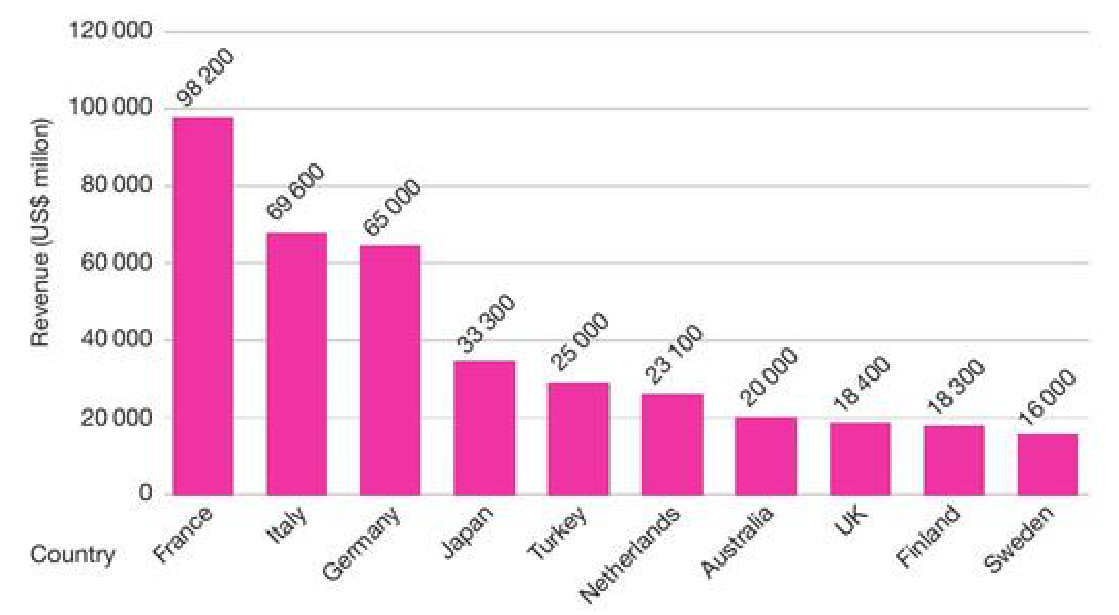
Reading the chart: the textbook gives France approximately US$98.2 billion of privatisation receipts over this period, compared with approximately US$18.4 billion for the UK. This shows that governments can raise large amounts by selling assets, although receipts vary greatly between countries.
To reduce inefficiency in the public sector
Private owners seeking profit may have stronger reasons to improve productivity, reduce unnecessary costs and respond to customers. Nonetheless, efficiency gains are not guaranteed: competition and effective regulation still matter.
As a result of deregulation
Removing legal barriers can encourage new businesses to enter a market. The textbook discusses bus and coach services as examples of where changing market rules can increase opportunities for private operators.
To reduce political interference
Private businesses may have more freedom to choose prices, investment, product ranges and growth without short-term government policy changes. However, regulators may still need to protect consumers, workers and the public interest.
The textbook describes historical proposals and sales relating to airports in India and Brazil. Supporters argued that private operators could improve productivity, introduce technology and provide investment. A government would also need to consider affordability, service levels and how to oversee a strategically important airport.
ABC is used in the chapter review to explore the trade-off between public-service broadcasting and commercial ownership. Supporters of public ownership value information, regional programming and diverse content; supporters of privatisation may point to efficiency, additional revenue or reduced public expenditure. Students should evaluate both sides.
| Potential benefit of privatisation | Risk or trade-off to consider |
|---|---|
| One-off revenue to the government | Loss of ownership and possible future income from the asset |
| Stronger profit and efficiency incentives | Less profitable services may be reduced or made more expensive |
| More competition after deregulation | Competition may remain limited in natural monopoly industries |
| Less day-to-day political control | Public interests may require regulation and accountability |
End-of-chapter understanding questions
Check key terms, apply ideas to public services and practise evaluation. Attempt each question first, then reveal the suggested answer.
Define a public corporation and distinguish it from a private limited company.
Show suggested answer
A public corporation is owned and controlled by the government, generally to provide services or meet public objectives. A private limited company is owned by private shareholders, whose shares are not freely offered to the public. A public corporation is not the same as a public limited company (PLC).
Explain three features of public corporations and why each matters.
Show suggested answer
They are state-owned, so government appoints or supervises their leadership; they are incorporated, so the organisation can enter contracts in its own name; and they are publicly accountable, so performance and use of public resources must be reported. Other textbook features include creation by law and state funding.
Why might government control of a strategic industry be considered important?
Show suggested answer
Industries such as water or energy may be important for national security and daily life. Public control can help protect reliable supply, quality and access, rather than allowing decisions to be made solely for private profit.
Explain two reasons why public corporations might be less efficient than private businesses.
Show suggested answer
With weak competition and reduced pressure to earn profit, managers may have fewer incentives to cut costs and raise productivity. Political interventions may also prevent timely commercial decisions. Neither outcome is inevitable.
What is a subsidy, and why might a government choose to subsidise a public transport business?
Show suggested answer
A subsidy is government support that covers some of an organisation’s costs. The government may subsidise transport to keep fares affordable or ensure socially valuable routes remain available despite low commercial revenue.
Explain the difference between selling a public corporation, deregulation and contracting out.
Show suggested answer
Sale transfers ownership of an existing state business to private investors. Deregulation removes restrictions so private firms can enter a market. Contracting out pays private firms to deliver a service that the public sector formerly supplied, without necessarily transferring ownership of the service or assets.
Suggest two reasons why a government may privatise a business.
Show suggested answer
Selling an asset can raise government revenue. Private owners may face stronger cost and efficiency incentives, while reduced political interference and increased competition may improve innovation and service.
Using the textbook’s historical Figure 5.1, compare France and the United Kingdom for privatisation revenue between 2000 and 2007.
Show suggested answer
The chart shows about US$98,200 million for France and US$18,400 million for the UK. France therefore raised about US$79,800 million more over the period. These are historical textbook figures, not current totals.
Why could the privatisation of an airport be beneficial, and what possible risk would need monitoring?
Show suggested answer
Private ownership may bring investment, innovation, stronger productivity incentives and less government funding. But the airport could raise charges or reduce less profitable services, so the government may still need suitable regulation and oversight.
The Australian Broadcasting Corporation (ABC) is used in the textbook as an example of a public broadcaster. Explain one argument for and one against privatising it.
Show suggested answer
Against privatisation: public ownership can support diverse, independent and less commercially profitable programmes, including regional coverage. For privatisation: private incentives might reduce costs or the government could raise funds from the sale. A decision should weigh service quality, access and independence against financial benefits.
Evaluate whether a government should privatise a loss-making water provider that serves remote communities.
Show suggested answer
Privatisation might improve management, investment and efficiency and reduce demands on taxpayers. However, remote customers may be expensive to supply and a profit-seeking owner may raise prices or reduce access. The best decision depends on the provider’s efficiency, the scale of losses, the importance of universal access and the effectiveness of regulation. Public ownership may remain preferable if affordable universal supply cannot be secured privately.
Chapter 5 recap
Public corporations are state-owned organisations, often created to provide important services. Public ownership may prevent wasteful duplication, protect strategic sectors and support access, but can involve taxpayer costs, inefficiency, political interference and management challenges. Privatisation transfers public activities or resources to the private sector through sales, deregulation, contracting out or property sales. Its benefits and costs must be judged in context.
Based on Chapter 5, Public Corporations (printed pp. 35–43) of the user-supplied Pearson Edexcel International GCSE (9–1) Business Student Book by Rob Jones (Pearson). Original notes, examples, questions and comparison tables are adapted in explanation from the supplied chapter. Figure 5.1 is sourced from and credited to the user-supplied textbook. Historical company examples and figures should not be treated as current data. IGCSE360 is not affiliated with Pearson.