
Chapter 7 · Classification of Businesses
How does an olive farm connect to an oil-processing plant, a delivery business and a supermarket? Explore the three sectors of production, how they depend on each other and why economies change.
Learning objectives
- Identify and distinguish the primary, secondary and tertiary sectors of business activity.
- Explain how businesses in different sectors depend on one another.
- Understand changes in employment between sectors over time, including de-industrialisation.
Primary Sector
The primary sector is the starting point of many production chains. Its output includes food crops, fish, timber, minerals, oil and natural gas. The textbook groups the following activities in this sector:
Agriculture
Agriculture involves growing crops and keeping animals. Some farms supply staple foods such as wheat and vegetables; others produce flowers, nursery plants or specialist products. Their output may be sold to consumers or used by manufacturers.
Fishing
Fishing means catching fish and other seafood using methods such as netting, trapping and trawling. These products may be sold fresh or processed and packaged by another business.
Forestry
Forestry includes managing forests to supply timber for products such as furniture and paper. The textbook also notes environmental protection, public access and wildlife management as related activities.
Mining and Quarrying
This involves extracting materials such as coal, iron ore, copper, limestone, salt, oil and natural gas. Example: the textbook identifies Saudi Aramco as a business associated with oil extraction.
A wheat farm is in the primary sector because it grows a raw material. A company milling the wheat into flour is in the secondary sector because it processes the material. A shop selling the flour provides a tertiary-sector service.
The textbook describes the Casillas family growing olives near Córdoba. During the busy harvesting season they employ about 15 workers and sell the crop to a local business that produces olive oil. Olive cultivation is primary; extracting and processing the oil is secondary. The family considers harvesting machinery to lower labour costs. This is a historical textbook example, not a claim about their present operations.
Secondary Sector
Secondary-sector businesses add value to raw materials by changing their form or assembling parts. The textbook gives examples including car manufacture, textiles, chemicals, engineering, food processing, construction, shipbuilding and energy utilities.
Finished and Semi-finished Goods
A semi-finished good (also called an intermediate good) is made by one business and used by another to produce a final product. Finished goods are ready for use or sale to the final buyer.
| Input or product | What happens? | Sector |
|---|---|---|
| Iron ore | Iron ore is extracted from the ground. | Primary |
| Steel sheet | Iron is processed into a material used by other manufacturers. | Secondary |
| Car body and components | An assembly plant puts numerous parts together to make cars. | Secondary |
| Car dealership | The completed vehicle is sold to a customer. | Tertiary |
The textbook describes a car assembly plant combining many different components, including brakes, seats, wiring and engines. The point is that one finished product may rely on many specialist suppliers.
A bakery that turns flour into bread is a secondary-sector business, even if customers buy bread directly at the bakery. A separate supermarket primarily provides a retail service, so it is in the tertiary sector.
Tertiary Sector
The tertiary sector connects producers with customers and provides many services used by households and other businesses. The book identifies these categories and examples:
Types of Services
| Service category | Textbook examples |
|---|---|
| Commercial services | Freight delivery, printing, debt collection and employment agencies |
| Financial services | Banking, insurance, investment advice and pensions |
| Household services | Plumbing, gardening, decorating and maintenance |
| Leisure services | Tourism, hotels, libraries and television |
| Professional services | Accountancy, legal advice and medical care |
| Transport | Train, taxi, bus and air services |
Some firms do more than one type of activity. For example, a farm may harvest fruit (primary), make fruit jam (secondary) and operate a visitor café (tertiary). Classify the particular activity being described rather than assuming every part of a business belongs in one sector.
A train operator is tertiary because it transports passengers. A factory manufacturing train carriages is secondary. A mining business supplying the metal for those carriages is primary.
Check your understanding · Halfway through
Answer these six questions after studying the three sectors, then open the suggested answers.
Define the primary sector and give two business activities found in it.
Show suggested answer
The primary sector extracts or produces raw materials from nature. Examples include crop farming, fishing, forestry and mining.
A company extracts limestone, another makes cement, and a third transports the cement to construction sites. Classify the three activities.
Show suggested answer
Limestone extraction is primary, cement manufacture is secondary, and freight transport is tertiary.
What is a semi-finished good? Give an example from car manufacturing.
Show suggested answer
A semi-finished or intermediate good is used as an input in a later production stage, such as a car seat or engine component used by an assembly plant.
Explain why a bakery can be classified differently from a supermarket selling bread.
Show suggested answer
A bakery processing flour into bread carries out secondary-sector production. A supermarket sells products to consumers and is a tertiary-sector retailer.
Identify three types of tertiary services and give an example of each.
Show suggested answer
For example: financial—banking; professional—legal advice; transport—bus service. Other suitable textbook categories count.
The Casillas family grows olives and sells them to an oil-processing company. How does each business add value?
Show suggested answer
The growers produce the raw olives in the primary sector; the processing company converts them into olive oil in the secondary sector, making a more usable product.
Interdependence
The three sectors are connected rather than separate. A business may need inputs from another sector as well as services for distribution, finance and promotion. The textbook uses cereal farmers, bakers and advertisers to show this relationship.
A Simple Production Chain
| Stage | Business activity | How it depends on another sector |
|---|---|---|
| 1 · Primary | Farmer grows wheat. | Needs transport, equipment, workers and business services. |
| 2 · Secondary | Miller produces flour; bakery makes bread. | Needs the wheat supplied by the farmer. |
| 3 · Tertiary | Delivery firm transports bread; retailer sells it. | Needs goods to transport and offer to customers. |
A second relationship works in the other direction: the transport business may rely on oil extracted in the primary sector, while the bakery may use tertiary-sector advertising to attract customers. Employees in secondary and tertiary industries also rely on primary-sector food production.
If a poor harvest reduces wheat supply, flour producers and bakers may face higher costs or shortages. Transport firms and shops could also be affected. A disruption in one sector can spread along the supply chain.
Changes in Sectors
The proportion of workers employed in each sector can change over time. In many economies, farming was once the main employer. Industrialisation increased factory employment; later, services grew in importance. This does not mean every country follows the same timetable or that manufacturing disappears.
Why Does De-industrialisation Happen?
- Changes in spending: as incomes rise, consumers may spend more on tourism, leisure, finance and other services.
- International competition: some manufacturing moves toward countries where production costs are lower, such as the examples of China, India and Brazil discussed in the book.
- Growth of public and other services: as countries develop, services provided by public-sector organisations and private firms can employ more people.
- Technology and productivity: machinery and automation can allow factories to produce goods with fewer workers.
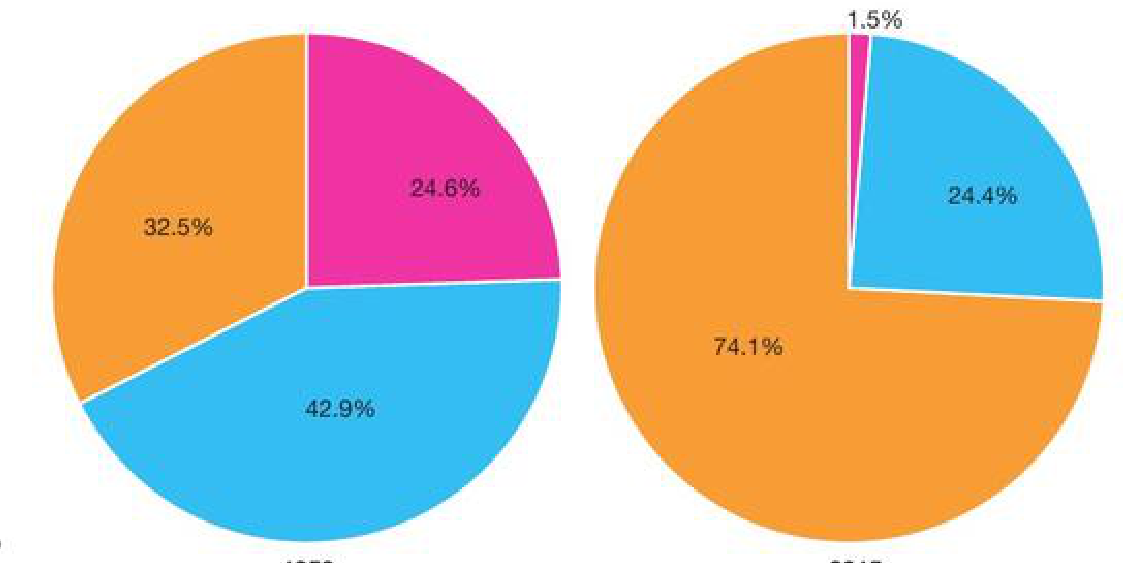
The tertiary sector rose from 32.5% in 1950 to 74.1% in 2015. Over the same period the secondary-sector employment share fell from 42.9% to 24.4%, and the primary-sector share from 24.6% to 1.5%. These are historical employment shares, not the percentage of national output or current data.
It is important to distinguish a falling share of employment from a fall in the number or value of goods produced. For example, greater factory automation may reduce employment even if production remains strong.
The historical case study describes Hisense producing household electrical goods such as refrigerators, televisions, laptops and smartphones (secondary), while also providing design, information technology and property-management services (tertiary). The case explains how a large manufacturer can be active across more than one sector.
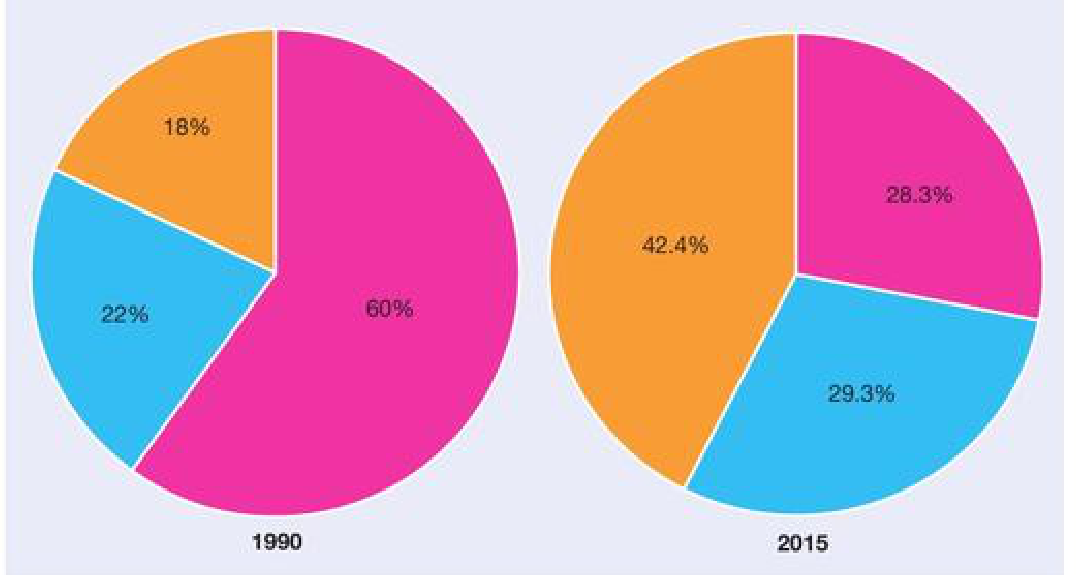
China’s primary-sector employment share fell from 60% (1990) to 28.3% (2015), while tertiary employment rose from 18% to 42.4%. Germany and China have different sector patterns, so do not assume that de-industrialisation happens identically everywhere.
Large vs Small Businesses
The book points out that both large and small businesses operate in all three sectors. The sector tells us the nature of production; business size tells us its scale. They are different classifications.
| Sector | Small business example | Large business example |
|---|---|---|
| Primary | Independent family olive farm | Large mining or oil-extraction corporation |
| Secondary | Small bakery producing its own bread | Multinational car manufacturer |
| Tertiary | Local plumber or taxi service | International airline or bank |
Small businesses may be sole traders or partnerships, but being small does not determine their sector. Large enterprises can also operate in agriculture, manufacturing or services. A business may combine activities from several sectors, as the Hisense example shows.
A local family farm starts selling packaged olive oil through its own shop. Its farming remains primary; processing olives into oil is secondary; the shop’s retail activity is tertiary. It may still be a small business despite operating across the three sectors.
End-of-chapter understanding questions
Questions move from knowledge and classification to interpreting historical figures, analysis and judgement. Attempt each question before revealing the answer.
What is the difference between the primary, secondary and tertiary sectors? Give one example of each.
Show suggested answer
Primary activities obtain raw materials, e.g. wheat growing. Secondary activities manufacture or process goods, e.g. flour milling. Tertiary activities provide services, e.g. delivering flour.
A timber company cuts trees, a furniture manufacturer makes tables, and a retailer sells the tables. Identify each sector.
Show suggested answer
Forestry / logging is primary; furniture manufacture is secondary; retailing is tertiary.
Explain the difference between finished and semi-finished goods.
Show suggested answer
Finished goods are ready for final use or sale to consumers. Semi-finished goods or intermediate goods are used as inputs in subsequent production, such as manufactured car components.
Using the textbook’s olive-farming example, explain one possible reason for investing in harvesting machinery.
Show suggested answer
The Casillas family considers machinery to lower labour costs at busy harvest times and remain competitive. The decision would depend on the investment cost and expected savings.
Discuss how the tertiary sector supports a secondary-sector bakery.
Show suggested answer
Transport moves flour and bread; banks provide finance; retailers sell products; advertising services help reach customers. The bakery needs services as well as raw materials.
What does the term interdependence mean? Explain a problem that could spread across sectors.
Show suggested answer
Interdependence means businesses rely on one another. A shortage of wheat can increase costs for millers and bakers and reduce goods available to transporters and retailers.
What is de-industrialisation, and why might factory employment fall even when output does not?
Show suggested answer
It describes a decline in manufacturing activity or its economic importance; in the book the emphasis is on the manufacturing employment share. Automation can maintain output while employing fewer factory workers.
According to Figure 7.2, which sector became the largest employer in Germany in 2015? What percentage did it represent?
Show suggested answer
The tertiary (service) sector, representing 74.1% of employment in the textbook’s 2015 data.
Using Figure 7.3, explain two changes in China’s sector employment between 1990 and 2015.
Show suggested answer
The primary share dropped from 60% to 28.3%; the tertiary share rose from 18% to 42.4%. The secondary share also increased from 22% to 29.3%.
A large company manufactures refrigerators and offers product design and IT services. Must all its activities belong to the same sector? Explain.
Show suggested answer
No. Manufacturing refrigerators is secondary activity, while design and IT services are tertiary activity. The textbook’s Hisense case illustrates this.
Assess whether technological change is the most important cause of declining manufacturing employment in developed economies.
Show suggested answer
Technology can reduce the number of workers needed per unit produced, but other explanations include international competition, changing spending toward services and expansion of public and private services. The strongest cause depends on the country and industry.
Chapter 7 recap
The primary sector supplies raw materials, the secondary sector transforms them into goods, and the tertiary sector provides services. Sectors are interdependent. Employment patterns can change through growth in services, international competition, technological change and de-industrialisation. Every sector includes businesses of different sizes.
Based on Chapter 7, Classification of Businesses (printed pp. 49–54) of the user-supplied Pearson Edexcel International GCSE (9–1) Business Student Book by Rob Jones (Pearson). Notes, tables, explanations and understanding questions are original adaptations. The two historical employment charts are cropped from the supplied textbook and retain their original data labels. IGCSE360 is not affiliated with Pearson.