
Chapter 8 · Decisions on Location
Why do businesses choose particular locations, and what can make them move? Explore the role of customers, labour, materials, the internet, government rules and trade blocs.
Learning objectives
- Explain the main factors influencing business location and relocation.
- Compare location needs for different types and sizes of businesses.
- Analyse how online trading, legal controls and trade blocs affect location decisions.
Factors Influencing the Location and Relocation of Businesses
A business must choose a location that allows it to operate effectively while controlling costs and reaching customers. Relocation means moving an existing business or part of its operations to another place. A site that was suitable when a business started may become less suitable as markets, costs or technology change.
Historically, many factories were built near coal, water or raw materials. Modern transport and energy networks have reduced the need to be near these resources in some industries, but the most important factors still depend on the type of business.
The textbook describes online retailers, consultants, teachers and information providers. A digital service provider may work wherever a reliable internet connection exists, while an online seller of physical products may still need a warehouse near transport links to deliver orders efficiently.
Proximity to Market, Labour, Materials and Competitors
Proximity (Closeness) to the Market
Businesses may want to be near customers to reduce delivery costs, improve speed and make buying convenient. This is particularly important for businesses selling heavy or bulky goods and for services delivered face to face. Component manufacturers may also locate close to car assembly plants to support frequent just-in-time deliveries.
The book describes Renault's factory in Tangier, near a major port and the European market. It identifies political stability, improved infrastructure, strategic sea links, access to local suppliers and the French language as factors influencing its decision. This is a historical textbook case.
Proximity to Labour
Firms need enough workers with the right skills at an affordable wage. A call centre may seek employees with language and communication skills, while a technology company may prefer an area with many trained IT workers. Wage rates differ across locations, so labour-intensive businesses sometimes relocate to lower-cost areas.
Proximity to Materials
Factories using bulky, heavy or perishable materials may operate near their suppliers to cut transport costs and delays. Some industries also require abundant water or inexpensive energy. Businesses requiring extensive land may choose industrial estates or business parks, where property costs can be lower.
Proximity to Competitors
Businesses may avoid rivals to face less direct competition, but locating near competitors can also attract customers who want to compare products. Restaurants, car dealers and shopping centres can benefit from clusters of similar businesses. The best choice depends on customer habits, local demand and the business's distinctive offer.
The textbook describes Abdullah Jaffer's proposed seafood restaurant in Manama. A site close to established restaurants may offer passing customers and a recognised dining area, but it also exposes the new business to strong competition. A decision should compare customer access, rent, parking and rival restaurants.
The Nature of Business Activity
The nature of the business activity changes which location factors matter most. A service business, an office, a factory and a farm do not have identical needs.
Services
Restaurants, shops and other customer-facing services need easy access, parking or public transport. Congestion may discourage customers. Retail parks and shopping centres attract visitors because several businesses and facilities are grouped together.
Office-Based Businesses
Consultancies, financial services, marketing agencies and customer service operations may value skilled staff, communications networks, transport and nearby amenities. A prestigious city-centre address can support a business's image, although rent may be higher than in out-of-town offices.
Manufacturing and Processing
Labour-intensive manufacturing may favour skilled and affordable workers; energy-intensive production may favour cheap power; oil refining may benefit from coastal ports; and large factories need sufficient affordable land. The best location is therefore specific to the production process.
Agriculture
Farms require suitable land and climate. Dairy farms need pasture and feed; fruit growers need appropriate soil, drainage and temperatures. Fishing businesses often need coastal access, while specialist shellfish operations may need particular water conditions.
A city-centre café prioritises passing customers. A chemical-processing plant may prioritise land, energy, safety and transport. A banana plantation needs a suitable climate and fertile land. One location would not suit all three.
Check your understanding · Halfway through
Try these six questions after studying the location factors and different types of business activity.
Explain why a manufacturer of heavy products might locate close to its customers.
Show suggested answer
It can reduce transport costs and delivery times, particularly when finished products are costly to move.
Give two reasons why Renault selected Tangier in the textbook case study.
Show suggested answer
Examples include port access and proximity to Europe, improved transport infrastructure, political stability, and local suppliers.
What is the difference between a brownfield and a greenfield site?
Show suggested answer
A brownfield site has been used for urban development before; a greenfield site is previously undeveloped land.
Why might a restaurant deliberately open near competing restaurants?
Show suggested answer
A recognised restaurant area can attract more customers and people who compare alternatives, although competition will be intense.
Identify one important location factor for each: a call centre, an oil refinery and a fruit farm.
Show suggested answer
Call centre: suitable skilled labour and connectivity. Oil refinery: port access and energy or transport. Fruit farm: suitable climate and soil.
A business moves to a cheaper industrial estate but is farther from its customers. Explain one trade-off.
Show suggested answer
Lower rent may improve profitability, but longer deliveries or reduced customer access could raise costs or reduce sales.
The Impact of the Internet on Location Decisions
Online shopping and digital communication give many businesses more flexibility in where they operate. An online retailer can sell nationally without shops in every town; a digital consultancy may serve customers internationally without being close to them. Physical products still need storage and delivery networks.
Reliable broadband, electronic communications and access to delivery infrastructure therefore become important location considerations. The textbook's historical Figure 8.1 shows estimated worldwide online retail sales rising between 2014 and 2018; these are historical estimates, not current sales figures.
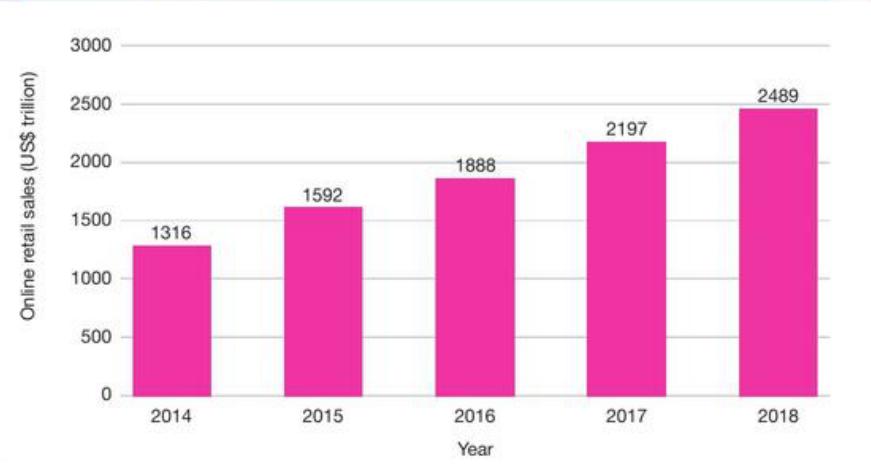
The chart shows an increase from US$1,316 billion in 2014 to US$2,489 billion in 2018, a rise of US$1,173 billion. This supports the textbook's argument that expanding online retailing can reduce the need for physical high-street stores, although distribution facilities remain important.
Influence of Legal Controls and Trade Blocs on Location
Legal Controls
Governments can influence where businesses operate through planning permission, restrictions, incentives and environmental rules. They may want to reduce congestion, protect residents from noise and pollution, safeguard natural areas or encourage jobs in regions with high unemployment.
Businesses may need permission before opening or expanding at a particular site. Large developments such as airports, power stations and chemical plants may require consultation, environmental assessment and feasibility studies, which can delay a project.
Government Incentives
Authorities may encourage investment in assisted areas by offering tax relief, low rents or financial support. Such measures can make a location more attractive, but businesses should compare the long-term operating costs and suitability of the site rather than choosing it solely for a grant.
A noisy night club next to homes may face objections. A manufacturer considering a sensitive natural area may need to choose a different site or meet strict environmental conditions.
Trade Blocs
A trade bloc is a group of countries that agree to reduce or remove trade barriers between their members. Businesses may choose to locate production inside a bloc so their products can be sold to member countries with fewer import restrictions or tariffs.
The textbook uses the African Union as an example in its discussion of regional trade arrangements and describes manufacturers locating factories in overseas markets to avoid import duties. The specific rules differ by arrangement and country, so businesses must examine the actual market-access conditions.
Suppose a car producer faces a tariff when exporting into a market. Building a plant within that market may reduce the tariff cost, but the producer must still consider labour, infrastructure, local regulations, transport and the cost of setting up the factory.
Large vs Small Businesses
The textbook explains that many small businesses, such as local shops, taxi operators and professional services, operate near their owners' homes and customers. Their owners may prefer a manageable journey and a familiar local market.
Larger businesses may have more resources and stronger reasons to compare sites across regions or countries. They may prioritise lower land costs, large labour pools, specialist facilities, transport links and opportunities to expand.
| Small local business | Large business |
|---|---|
| Often serves a limited local market | May serve national or international markets |
| Owner convenience and customer access can be central | May compare several countries or regions |
| Limited funds may restrict choice | More options but potentially higher relocation costs |
Overall: the most appropriate site is the one that best balances costs, customers, employees, suppliers, legal requirements and the firm's objectives. There is rarely a single factor that determines the answer.
End-of-chapter understanding questions
Test your knowledge, calculations, application and judgement. Open each answer after trying the question yourself.
Define relocation and identify two reasons a firm might relocate.
Show suggested answer
Relocation means moving operations to another site. Reasons include lower operating costs, expansion space, better labour supply or closer access to markets.
Explain why proximity to materials matters more for some manufacturers than others.
Show suggested answer
Businesses using large quantities of heavy or perishable inputs may save substantial transport costs by locating near suppliers; light, valuable products may be easier to transport.
Describe two location factors important to a service business with walk-in customers.
Show suggested answer
Easy access or parking and proximity to customers can increase convenience and sales; other valid factors include rent and competition.
Explain how an online retailer can operate away from a high street while still serving a national market.
Show suggested answer
Customers place orders online, while a warehouse and delivery network handle storage and distribution. Reliable internet connectivity is also needed.
Use the textbook chart to calculate the estimated increase in online retail sales between 2014 and 2018.
Show suggested answer
US$2,489 billion − US$1,316 billion = US$1,173 billion (equivalent to US$1.173 trillion). These are historical textbook estimates.
Give two reasons governments influence business location decisions.
Show suggested answer
They may protect residents and the environment, reduce congestion, attract investment or create employment in disadvantaged areas.
Explain one advantage and one disadvantage of locating in an assisted area.
Show suggested answer
An incentive such as lower rent or tax relief may reduce costs, but the location could be far from customers or have weaker transport and labour access.
How might a trade bloc influence a manufacturer’s choice of country?
Show suggested answer
A firm may locate inside the bloc to benefit from lower barriers when selling to member markets, while weighing other production costs.
Why might a small shop choose a different location from a large multinational factory?
Show suggested answer
The shop may need local footfall and owner convenience; the factory may prioritise large sites, low costs, workforce availability and international transport.
The textbook describes a proposed seafood restaurant in Manama. Evaluate a location near several established restaurants.
Show suggested answer
The area may attract diners and provide access to target customers, but rivals compete for those customers. The decision depends on rent, footfall, parking, demand and the restaurant’s distinctive offering.
A new insurance call centre needs 2,000 skilled employees. Compare a cheaper out-of-town site with a central site near public transport. Which would you recommend?
Show suggested answer
The out-of-town site may offer lower rent and incentives; the central site may attract qualified staff through better transport and amenities. A justified recommendation should compare recruitment, operating costs, connectivity and expansion needs.
Chapter 8 recap
Location decisions depend on markets, labour, materials, competitors, business activity, online connectivity, legal controls and trade arrangements. Small and large businesses may prioritise different factors. Good decisions weigh both the benefits and costs of a site, rather than considering only one advantage.
Based on Chapter 8, Decisions on Location (printed pp. 55–63) of the user-supplied Pearson Edexcel International GCSE (9–1) Business Student Book by Rob Jones (Pearson). Notes, examples and questions are original adaptations. The historical online-retail chart is cropped from the supplied textbook. IGCSE360 is not affiliated with Pearson.