
Chapter 9 · Globalisation
Why are businesses and economies increasingly connected, and what opportunities and threats result?
Learning objectives
- Explain the concept and causes of globalisation.
- Describe the role of governments in international trade.
- Assess opportunities and threats for businesses of different sizes.
The Concept of Globalisation
Globalisation means the growing integration of the world’s economies. Countries, consumers and businesses are increasingly connected through international trade, investment, travel, technology and the movement of workers. Some companies operate as though the world were one large market, rather than many separate national markets.
A business may raise money in one country, design products in another, manufacture elsewhere and sell internationally. This creates opportunities but also means economic problems can spread between countries.
- Trade: goods and services move across borders more freely where barriers are low.
- People: international employment and migration connect labour markets, subject to restrictions.
- Interdependence: events such as the 2008 financial crisis can affect several economies.
- Capital: savings, share investment and business ownership cross borders.
- Technology: knowledge and intellectual property are shared or licensed internationally.
The book compares Toyota, Volkswagen, Hyundai, General Motors, Ford and Renault-Nissan using historical 2015 sales. Car manufacturers serve international markets and rely on cross-border production networks.
Globalisation is not complete. Immigration rules, tariffs, planning restrictions and other barriers still limit international activity.
Reasons for Globalisation
The textbook explains that modern globalisation accelerated from the 1980s. Several changes have made international business easier:
- Technology: computers and the internet let firms exchange data instantly, coordinate distant operations and reach overseas customers.
- Transport: improved networks and lower air-travel costs allow more business travel and cheaper movement of goods.
- Deregulation and privatisation: reducing restrictions and opening markets encourages international competition.
- Tourism: travellers experience foreign products, creating demand for them at home.
- Saturated domestic markets: when home-market growth is limited, firms seek international customers and lower-cost production locations.
A small online retailer can accept orders from other countries using internet advertising and digital payments, but must still consider delivery costs, customs rules and different consumer tastes.
Government and Globalisation
Government policy can either support or restrict globalisation. International integration depends partly on governments allowing businesses and people to operate across borders.
- Trade barriers: tariffs, quotas and import rules can make international trade harder or more expensive.
- Migration controls: visa and work-permit rules affect international labour mobility.
- Permission and regulation: firms may need licences or planning approval to establish overseas operations.
- Support for trade: simpler rules, more open borders and international cooperation can help global businesses.
The textbook links increased international air travel with tourism, business travel and budget airlines. It gives examples from India, including IndiGo, GoAir, JetLite and Simplifly Deccan, as historical cases.
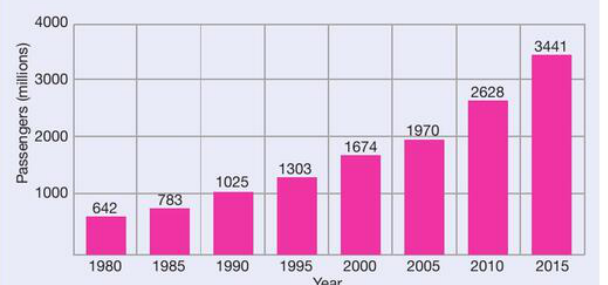
Passenger numbers rose from 642 million in 1980 to 3,441 million in 2015. The percentage increase was approximately 436%: (3,441 − 642) ÷ 642 × 100.
Check your understanding · Halfway
Try each question before revealing its suggested answer.
Define globalisation and give an example of a business operating across borders.
Show suggested answer
Globalisation is the growing integration of world economies. A firm might design in one country, manufacture in another and sell internationally.
Explain two reasons why globalisation has increased.
Show suggested answer
The internet helps firms coordinate and sell worldwide; improved transport lowers the cost and difficulty of moving people and goods.
Why might governments restrict international trade?
Show suggested answer
They may protect domestic industries or pursue other economic or political objectives using tariffs and other barriers.
What is economic interdependence?
Show suggested answer
Countries are connected so that events in one economy can affect others.
Calculate the percentage increase in airline passengers from 642 million to 3,441 million.
Show suggested answer
(3,441 − 642) ÷ 642 × 100 ≈ 436%.
How does the internet help a small business trade globally?
Show suggested answer
It can reach and communicate with overseas customers and take online orders, but must manage payment, shipping and regulations.
Opportunities of Globalisation for Businesses
Globalisation may increase sales, reduce average costs, improve recruitment and give firms more choice of location. The benefit depends on the business and its circumstances.
Access to Larger Markets
A business can reach far more customers than in its home market. This can increase sales revenue, allow growth and potentially raise profit. It must still understand foreign tastes and local competition.
Lower Costs
Larger output can lead to economies of scale, such as bulk-buying discounts and spreading fixed costs over more units. International sourcing may also reduce some input costs, though shipping and coordination may add expenses.
Access to Labour
International recruitment can fill skill shortages, allow rapid expansion and provide specialist expertise. A larger labour pool may affect wage costs, but migration rules and fair employment conditions still matter.
Reduced Taxation
Businesses may choose locations with lower taxes. The textbook uses Ireland’s 12.5% corporation tax rate on trading income as a historical illustration, not a statement of current tax rules. Legal obligations, workforce and operating costs must also be considered.
The textbook uses Samsung, Apple and Huawei to illustrate international smartphone markets. It describes historical growth in sales and competition between multinational producers.
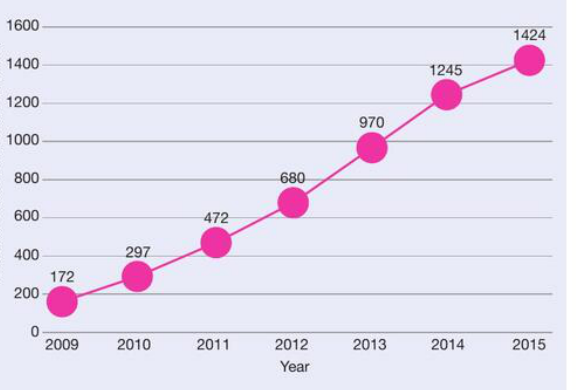
The chart reports 1,424 million handsets sold in 2015. Using the textbook’s 21.4% Samsung market share, estimated Samsung sales were 304.7 million (1,424 × 0.214).
Threats of Globalisation to Businesses
Globalisation also exposes firms to strong competitors, overseas takeovers and unexpected events in other economies.
Competition
Foreign producers can enter domestic markets. Some have powerful brands, greater finance and lower costs. Local firms may lose market share or close, even though consumers may benefit from more choice and lower prices.
International Takeovers
International capital flows allow firms to acquire businesses in other countries. A hostile takeover occurs when the target company does not agree to the takeover. The textbook mentions Sanofi’s 2016 bid for Medivation as a historical example of a hostile bid.
Increased Risk of External Shocks
Economic interdependence means events in one economy can affect businesses elsewhere. Financial crises, recessions, currency movements and changes in trade arrangements can disrupt demand and costs. The textbook discusses market reactions to the UK’s 2016 EU referendum as a historical example.
A local manufacturer may benefit from imported components but lose sales to cheaper foreign finished products. The outcome depends on product quality, costs, brand strength and ability to adapt.
Large vs Small Businesses
Large multinationals often have more finance, experienced staff and distribution networks to exploit global markets. They can benefit from international sales, economies of scale and access to global suppliers.
Small businesses can also benefit. An online seller may reach customers abroad without opening overseas shops; a specialist producer may supply a multinational. However, smaller firms often have fewer resources to withstand global competition or external shocks.
Large businesses
- Finance for international expansion and marketing.
- Potential for greater economies of scale.
- Ability to spread operations across markets.
- Complex coordination and reputational risks.
Small businesses
- Can sell niche products globally online.
- May supply large international firms.
- Often flexible in specialised markets.
- More vulnerable to powerful rivals and shocks.
Judgement: globalisation may be an opportunity or threat depending on the firm’s size, resources, competitiveness and international exposure.
End-of-chapter questions
Try each question before revealing its suggested answer.
State two features of globalisation.
Show suggested answer
Examples include international trade, cross-border capital, movement of labour, technology sharing and economic interdependence.
Why do firms expand overseas when their domestic markets are saturated?
Show suggested answer
They seek new customers, revenue and potential profit where domestic sales growth is limited.
How can globalisation produce economies of scale?
Show suggested answer
Higher output allows fixed costs to be spread across more units and can provide bulk-purchasing discounts.
Give one benefit and one limitation of recruiting internationally.
Show suggested answer
It may fill skill shortages, but migration rules or recruitment costs can limit its effectiveness.
Why might a firm locate in a country with lower taxes?
Show suggested answer
It may reduce its tax costs, while still needing to comply with laws and consider operational factors.
Estimate Samsung’s 2015 sales if the global market was 1,424 million phones and its share was 21.4%.
Show suggested answer
1,424 × 0.214 = 304.736 million, approximately 305 million handsets.
Explain two threats to small domestic firms from globalisation.
Show suggested answer
Foreign competition can reduce sales, and overseas economic shocks can affect costs or demand.
What is a hostile takeover, and how can globalisation encourage it?
Show suggested answer
It is a takeover opposed by the target. Cross-border capital flows make foreign acquisitions easier.
How might a recession abroad affect an exporter?
Show suggested answer
Foreign customers may cut spending, reducing export orders and revenue.
Evaluate whether globalisation benefits every business.
Show suggested answer
Some gain larger markets, lower costs and labour access; others face stronger rivals, takeovers or shocks. The impact depends on circumstances.
Should a small clothing retailer start selling overseas online? Justify your answer.
Show suggested answer
A limited trial could work if demand is strong and shipping, returns, exchange rates and foreign competition are manageable. Compare expected revenue with added costs.
Chapter 9 recap
Globalisation links economies through trade, investment, labour, technology and international business. It can open markets, lower costs and improve recruitment, but also creates competition, takeover risks and exposure to external shocks.
Based on Chapter 9, Globalisation (printed pp. 64–71) of the user-supplied Pearson Edexcel International GCSE (9–1) Business Student Book by Rob Jones (Pearson). Notes and questions are original adaptations. Historical figures are cropped from the supplied textbook. IGCSE360 is not affiliated with Pearson.