
Chapter 10 · The Importance and Growth of Multinational Companies
Why do multinationals expand internationally, and what do they mean for the countries where they operate?
Learning objectives
- Understand the importance and growth of multinationals.
- Explain the benefits to a business of becoming a multinational.
- Explain benefits and possible drawbacks for a host country or economy.
The Importance and Growth of Multinationals
A multinational company (MNC) is a business with operations in more than one country. For example, it may have its head office in one nation, factories or branches in others, and customers worldwide. Multinationals have become increasingly important as trade and investment between countries have grown.
The textbook reports that multinationals contributed about 10% of world GDP and 66% of global exports, and that their number rose from around 7,000 in 1970 to about 78,000 in 2005. These are historical figures from the book, illustrating the scale and growth of multinationals at that time, not estimates for 2026.
Their influence extends beyond their own sales. They can employ local people, pay taxes, buy from local suppliers and spread technology. However, because they are often large and powerful, governments and communities also consider the social and environmental effects of their activities.
South Korea-based LG Electronics is used as an example. The book states that in 2016 it had 125 global operations and about 77,000 employees. It organised products into home entertainment, mobile communications, vehicle components and home appliances/air solutions.
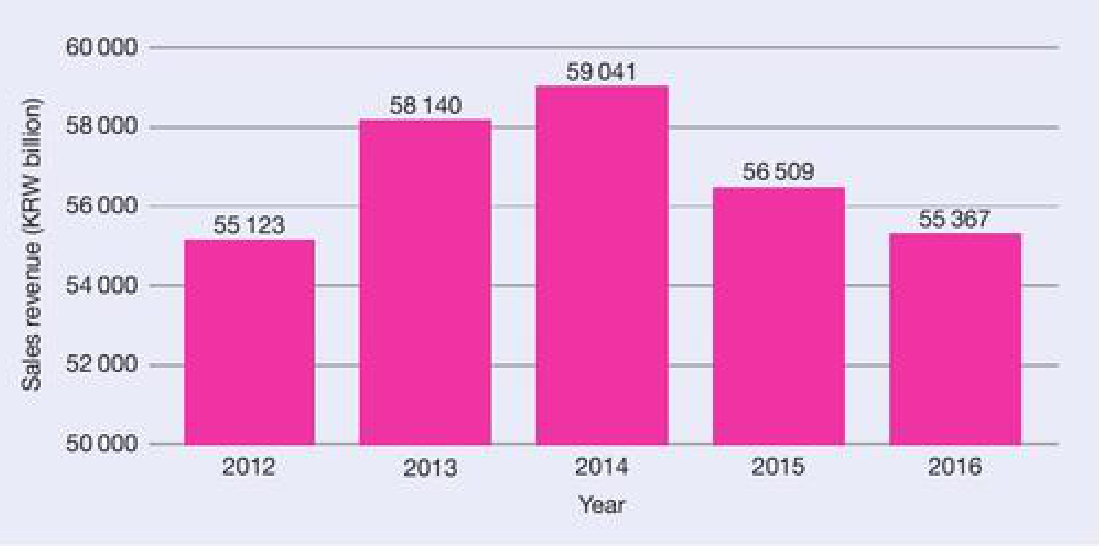
LG’s revenue rose from KRW 55,123 billion in 2012 to KRW 59,041 billion in 2014, before declining to KRW 55,367 billion in 2016. Use these five data points to practise trends and percentage-change calculations. For example, the change from 2012 to 2016 was (55,367 − 55,123) ÷ 55,123 × 100 ≈ 0.44% increase.
The textbook’s historical 2015 ranking includes Walmart, State Grid, China National Petroleum, Sinopec Group and Royal Dutch Shell as examples of very large multinational firms. Most of these listed businesses were in the oil and gas sector.
How Have Multinationals Developed?
The textbook identifies three main reasons why some businesses have developed into multinationals: exploiting economies of scale, successful marketing and technical or financial advantages.
Economies of Scale
Selling to customers worldwide can increase the number of units a firm produces. Higher output may reduce average costs through bulk buying, spreading fixed costs and improving efficiency. Multinationals can also access resources in different countries, including labour, capital and commodities. Their scale may allow them to negotiate lower prices from suppliers.
Marketing
Some firms grow internationally because they develop successful products and easily recognisable brands. The textbook names Starbucks and McDonald’s as businesses that built brands and then expanded across countries. Advertising, consistent branding and marketing to international customers can support growth. International businesses must also protect their inventions and brands.
Technical and Financial Superiority
A successful large business may have more finance, specialist staff and technical know-how than small competitors. It may invest in research and development, employ skilled workers and afford the risks involved in entering new markets. The financial strength to establish foreign operations can reinforce its position in global markets.
A company with a strong brand and large marketing budget may enter overseas markets more easily than a small start-up. But expansion is costly and does not guarantee success if consumer tastes or regulations differ.
Benefits to a Business of Becoming a Multinational
Becoming multinational can bring several advantages to the business itself. These are distinct from the benefits a host country may receive when a multinational opens operations there.
Larger Customer Base
A multinational reaches customers in many countries instead of relying only on its domestic market. If demand exists and the firm sells competitively, a wider customer base may increase sales, market share, revenue and ultimately profit. This can reduce dependence on a single market, although a firm must understand foreign customer needs.
Lower Costs
Multinationals can gain economies of scale, purchase materials and other resources at competitive prices, and sometimes borrow money more cheaply. Building factories closer to overseas customers can reduce transport costs; the textbook highlights the importance of this for large goods such as cars. Lower costs may improve profit margins or help the business compete on price.
Higher Profile
Operating internationally can make a brand widely known, helping attract customers and retailers. The textbook lists Google, McDonald’s, Microsoft, Apple and Coca-Cola as examples of globally recognised names. Strong branding can also reinforce customer trust, but reputation may be damaged quickly by negative publicity in any market.
Avoiding Trade Barriers
A business may establish a factory inside a market rather than export products across trade barriers. Producing locally can mean goods are treated as domestic output for certain purposes, although the firm still must follow local trading rules. The textbook cites Japanese car manufacturers, including Honda, Nissan and Toyota, establishing factories in the UK as a historical illustration of seeking access to European markets. Trade arrangements change over time.
Lower Taxes
A multinational may consider different business-tax regimes when deciding where to locate operations or head offices. The textbook mentions lower tax rates in countries such as Ireland, Cyprus, Liechtenstein and Gibraltar as historical examples. Tax decisions remain subject to legal rules, and current rates may be different. Location also depends on workers, transport, customers and infrastructure.
The textbook describes Nike as a multinational with production in numerous countries and a powerful international brand. It reports historical 2015 revenue of US$7,700 million and 2016 advertising expenditure of US$804 million. Global marketing helps explain how the firm maintains its profile; overseas production can improve its access to markets and resources.
Overall: The ability to sell in more countries does not automatically mean higher profit. A multinational must still pay for foreign premises, management, transport, promotion and compliance.
Check your understanding · Halfway
Answer the questions first, then select Show suggested answer to check your understanding.
What makes a company multinational rather than simply an exporter?
Show suggested answer
A multinational owns or operates business activities in more than one country, such as factories or outlets abroad. An exporter may only sell abroad from its home country.
Give two reasons multinationals have grown over time.
Show suggested answer
Possible reasons are economies of scale, successful international marketing, strong finances, technical superiority and access to global resources.
Explain how economies of scale may improve a multinational’s competitiveness.
Show suggested answer
Higher output spreads fixed costs over more units and may allow bulk discounts. Lower average costs can support lower selling prices or higher margins.
Using the LG chart, identify the highest revenue year and give its value.
Show suggested answer
2014, with sales revenue of KRW 59,041 billion.
Explain the benefit of operating a car factory close to overseas customers.
Show suggested answer
Producing near customers can cut transport costs and delays; depending on trading rules, local production may also reduce the impact of tariffs.
Why might a globally recognised brand help a multinational expand?
Show suggested answer
Strong brand recognition can build customer confidence and reduce the difficulty of attracting sales when entering new markets.
Benefits of Multinationals to a Country/Economy
The host country is the country where a multinational establishes operations. An investment may benefit both the MNC and the host economy when it creates output, employment and opportunities for local firms.
Increase in Income and Employment
A new factory, office or restaurant may employ local workers who earn wages and spend their income. The business may also buy from local suppliers, creating indirect employment in transport, catering, maintenance and other services. Higher employment and spending can increase national output and living standards.
Increase in Tax Revenue
Multinationals may pay taxes on profits and other activities in the host country. Governments can use tax revenue to finance public services such as schools, healthcare and infrastructure. However, actual tax benefits depend on local rules and how the business structures its operations.
Increase in Exports
Goods produced by a multinational in the host country and sold overseas count as that country’s exports. Export earnings can bring foreign currency into the economy, contributing to currency reserves and supporting international trade.
Transfer of Technology
Multinationals may bring new machines, processes, technical knowledge and quality standards. Local businesses supplying the multinational can learn new methods or receive training, helping them modernise their own production.
Improvement in the Quality of Human Capital
Staff can gain skills, qualifications and work experience through multinational training programmes. These improvements in human capital can remain valuable to the host economy even if the worker later changes employer. The textbook mentions investment in IT education in India as an example of developing skills.
Enterprise Development
An MNC can encourage local entrepreneurs to establish businesses providing food, transport, maintenance, security or accommodation. These smaller firms can grow by supplying the multinational and its workforce, although dependence on one large customer carries risk.
The book reports Mars’ plans for a US$160 million chocolate factory in Pune, expected at the time to create 200 direct jobs and around 1,000 indirect jobs. This historical plan illustrates how an investment could support employees, local suppliers and the host government. Expected jobs are not verified current employment figures.
For students, distinguish direct benefits (jobs inside the multinational) from indirect benefits (jobs and sales generated at suppliers).
Possible Drawbacks of Multinationals to a Country/Economy
Multinational activity may also impose costs on the host economy. The size of those costs depends on the industry, environmental safeguards, workers’ rights and the effectiveness of regulation.
Environmental Damage
Some activities use large amounts of energy, water or natural resources and may create pollution. Mining, oil extraction and other extraction industries can harm the land, rivers or surrounding communities if controls are weak. Regulators, businesses and communities may need to monitor environmental impacts.
Exploitation of Less Developed Countries
The textbook raises several possible concerns: low wages, unsafe conditions, child labour, limited local tax payments and excessive dependence on exporting commodities. A country reliant on a narrow range of basic products may be vulnerable when world prices change. If the multinational dominates the economy, it may also make it harder for domestic manufacturing and services to develop. These outcomes are risks, not characteristics of every multinational.
Repatriation of Profits
A multinational may transfer some profits made abroad back to its home country. This is called repatriation of profits. Although the host may benefit from wages, taxes and supplier purchases, money sent abroad is not retained locally and can reduce the investment’s overall contribution to the host economy.
Lack of Accountability
Large multinationals may be difficult to regulate across several countries. Where local laws are weak or poorly enforced, a firm might avoid responsibilities or take advantage of loopholes. The textbook notes that pressure groups can investigate and publicise concerns, encouraging greater accountability. It uses historical oil spills and waste damage in the Niger Delta as an example of harm to livelihoods.
The chapter review discusses McDonald’s growth into a global restaurant business and reports historical worker protests and wage concerns in several countries. It also presents McDonald’s statements about pay rises and employee training. The case illustrates both the employment benefits and the workplace criticisms that can accompany a large multinational.
Possible host-country gains
- Jobs and incomes
- Taxes and export earnings
- Technology and skills transfer
- Opportunities for local suppliers
Possible host-country costs
- Pollution and environmental damage
- Unfair working conditions
- Profits transferred abroad
- Limited accountability or dependence
Balanced judgement: A host country may gain greatly from a multinational when jobs are decent, taxes are paid, local suppliers benefit and environmental rules are enforced. Benefits can be much smaller when profits leave the country and negative effects are not managed.
End-of-chapter questions
Answer the questions first, then select Show suggested answer to check your understanding.
State two defining features of a multinational company.
Show suggested answer
It operates in more than one country and may have international production sites, branches or other facilities while coordinating activities across countries.
Explain how technical and financial superiority can support multinational growth.
Show suggested answer
More finance can fund overseas facilities and advertising, while specialised technology, research and skilled workers improve products and efficiency.
Name and explain three benefits to a business of becoming multinational.
Show suggested answer
Examples: a larger customer base increases potential sales; economies of scale reduce average costs; foreign operations can overcome some trade barriers; wider recognition strengthens a brand.
Why might a multinational establish production inside a country rather than export there?
Show suggested answer
It may reduce freight costs, serve customers faster or avoid some import barriers, subject to local rules.
In the Mars case, how many total direct and indirect jobs were expected?
Show suggested answer
The textbook expected 200 direct and about 1,000 indirect jobs, giving around 1,200 jobs in total. These were forecasts made at the time.
Explain how a multinational can increase a host country’s exports and foreign currency reserves.
Show suggested answer
Goods made locally for overseas customers are recorded as exports; selling them earns foreign currency for the economy.
Distinguish technology transfer from improvement in human capital.
Show suggested answer
Technology transfer brings equipment, methods or knowledge to local production. Improved human capital means workers gain skills, training and experience.
Explain two possible problems caused by multinationals in less developed economies.
Show suggested answer
Examples include pollution and environmental damage; low wages or poor conditions; dependence on one primary industry; or profits repatriated overseas.
What is profit repatriation, and why may it concern a host government?
Show suggested answer
It is sending profits from a foreign operation back to the firm’s home country. Some income then leaves the host economy rather than being reinvested locally.
A multinational opens a factory employing 400 people but is criticised for water pollution. Evaluate the effect on the host country.
Show suggested answer
The factory brings wages, supplier demand and possibly taxes, but pollution may harm health, livelihoods and the environment. The overall effect depends on enforcement, damage, wages and the benefits sustained over time.
Assess whether a government should actively attract a new multinational investor.
Show suggested answer
It may attract investment where jobs, skills, taxes and local purchases outweigh environmental and social costs. Conditions on labour standards, tax compliance and pollution controls can improve outcomes; the answer depends on the specific project.
Chapter 10 recap
Multinationals operate in more than one country. They can gain larger markets, lower costs and stronger brands. Host economies can gain jobs, taxes, exports, skills and technology, but they may also face pollution, unfair practices and profits leaving the country. Always consider both sides when evaluating their impact.
Based on Chapter 10, The Importance and Growth of Multinational Companies (printed pp. 72–80) of the user-supplied Pearson Edexcel International GCSE (9–1) Business Student Book by Rob Jones (Pearson). Notes and questions are original adaptations. Figure 10.1 is a high-resolution crop from the supplied textbook. All case-study statistics refer to the historical textbook period. IGCSE360 is not affiliated with Pearson.