
Chapter 11 · International Trade and Exchange Rates
Understand international trade, practise currency conversion and evaluate how changing exchange rates affect businesses.
Learning objectives
- Understand international trade and the difference between imports and exports.
- Explain the purpose of exchange rates and carry out currency calculations.
- Analyse the effects of exchange-rate changes on importers, exporters and competitiveness.
International Trade
International trade is the buying and selling of goods and services between countries. Businesses may sell some of their output abroad and purchase goods, machinery or other resources from overseas suppliers. In the textbook, international trade is linked to greater business growth, competition and consumer choice.
- Countries can obtain goods that cannot be produced domestically, perhaps because of climate or resources.
- Firms and consumers may buy certain goods from overseas at lower prices.
- International suppliers give consumers a wider choice of products.
- Businesses can sell surplus output or commodities beyond what the domestic market needs.
- International demand may help a business expand, though it also exposes the business to competition.
Toyota is a Japanese vehicle manufacturer with factories and operations in many countries. The textbook compares its regional sales in 2003 and 2017. Its overseas sales illustrate why international markets are significant to multinational manufacturers.
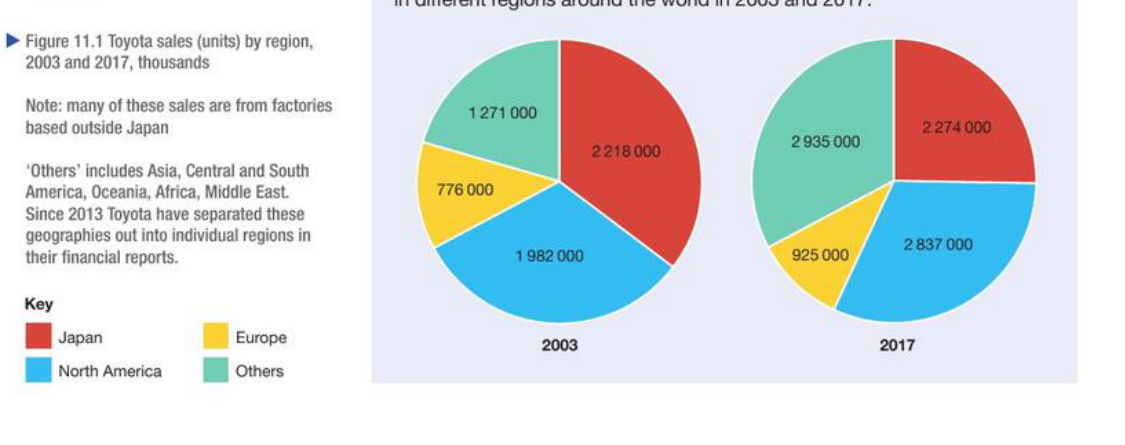
The book’s charts show Toyota’s sales growing from roughly 6.25 million vehicles in 2003 to 8.97 million in 2017. Sales in the “Other” regions increased notably, although the figures are historical and should not be taken as current results.
Visible and Invisible Trade
When a business supplies an overseas customer it makes an export; when it buys from an overseas supplier it makes an import. Exports and imports include physical goods and services, but the textbook distinguishes two types of trade.
| Type | What is traded? | Textbook examples |
|---|---|---|
| Visible trade | Physical goods | India exporting textiles and jewellery; importing oil, fertiliser and chemicals |
| Invisible trade | Services | Tourist spending in India is a service export; paying foreign carriers to transport goods is a service import |
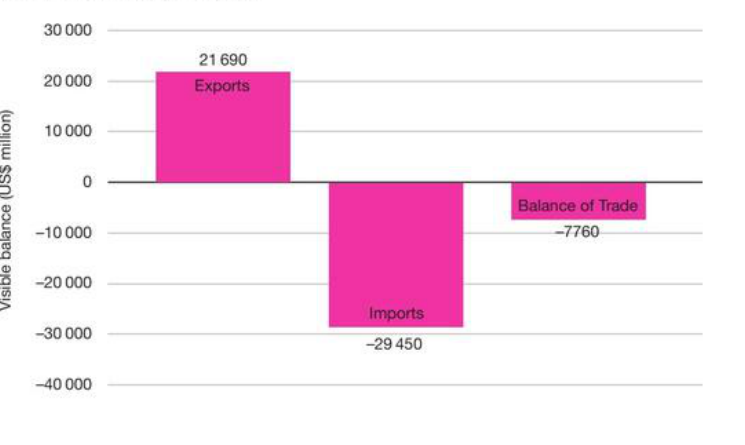
For the year to July 2016, the textbook gives India’s visible exports as US$21,690 million and imports as US$29,450 million. The balance was 21,690 − 29,450 = −US$7,760 million: a visible trade deficit.
Kenya’s historical exports included agricultural products and tea, while its imports included machinery, transport equipment, motor vehicles and plastics. The book’s 1998–2016 charts indicate that both trade flows grew over time, with imports substantially higher than exports in later years.
A deficit in visible trade does not by itself tell us the overall balance for all goods and services, because invisible trade also matters.
What Is an Exchange Rate?
Different countries use different currencies. Businesses and individuals must therefore convert money when making some international payments. An exchange rate states the value of one currency in terms of another. The direction of the quote matters: a rate of £1 = US$1.50 means one pound buys 1.50 dollars.
How to Calculate Currency Conversions
Use the rate’s units to decide whether to multiply or divide. If £1 = US$1.50, convert pounds to dollars by multiplying by 1.50; convert dollars to pounds by dividing by 1.50. Always state the answer’s currency.
| Given | Conversion | Result |
|---|---|---|
| £400,000 and £1 = €1.20 | £400,000 × 1.20 | €480,000 |
| €55,000 and €1 = US$1.10 | €55,000 × 1.10 | US$60,500 |
| US$300,000 and AED 1 = US$0.30 | US$300,000 ÷ 0.30 | AED 1,000,000 |
| Rs20,000 and US$1 = Rs50 | Rs20,000 ÷ 50 | US$400 |
These are the hypothetical textbook examples, not present-day exchange rates.
The Glasgow-based agricultural machinery manufacturer sells to the United States and imports components from Germany and Spain. Its textbook transactions show how an exporter receives foreign currency while an importer must pay foreign suppliers. At £1 = US$1.50, a £3.6 million export is worth US$5.4 million. At £1 = €1.10, €2.5 million in German components cost about £2.27 million.
Check your understanding · Halfway
Try each question before opening its suggested answer.
Give two reasons why countries trade internationally.
Show suggested answer
Trade helps countries obtain unavailable goods, source cheaper supplies, offer consumers more choice and sell surplus commodities.
Distinguish an export from an import using Kenya as an example.
Show suggested answer
An export is sold overseas, such as Kenyan tea. An import is bought from abroad, such as machinery or motor vehicles.
What is the difference between visible and invisible trade?
Show suggested answer
Visible trade is trade in physical goods; invisible trade is trade in services, such as tourism and banking.
Calculate India’s visible trade balance if goods exports are US$21,690 million and imports US$29,450 million.
Show suggested answer
21,690 − 29,450 = −US$7,760 million, a visible trade deficit.
If £1 = US$1.50, how many dollars would a £2,000 shipment cost?
Show suggested answer
£2,000 × 1.50 = US$3,000.
The rate is £1 = €1.10. How many pounds does Ronnie Mackay need to pay for €2.5 million of components?
Show suggested answer
€2,500,000 ÷ 1.10 = approximately £2,272,727.27.
The Impact of Changes in the Exchange Rate on Importers and Exporters
A change in the exchange rate alters the price of a country’s exports for overseas buyers and the price of its imports for domestic buyers, assuming other prices stay the same. The textbook uses a fall and a rise in the value of the pound to explain these effects.
Fall in the Exchange Rate
A depreciation is a fall in the value of a currency. For example, suppose the pound falls from £1 = US$1.50 to £1 = US$1.20:
- Exports become cheaper to US customers: UK goods worth £2 million initially cost US$3 million, but now cost only US$2.4 million. Demand for exports may rise.
- Imports become dearer to UK buyers: imports worth US$600,000 initially cost £400,000, but now cost £500,000. Demand for imports may fall.
Rise in the Exchange Rate
An appreciation is a rise in the value of a currency. Suppose the pound instead rises from £1 = US$1.50 to £1 = US$2.00:
- Exports become more expensive to US customers: the same £2 million shipment costs US$4 million instead of US$3 million. Demand may fall.
- Imports become cheaper to UK buyers: the same US$600,000 shipment costs £300,000 instead of £400,000. Demand may rise.
| Change in the home currency | Exports for foreign buyers | Imports for domestic buyers |
|---|---|---|
| Falls / depreciates | Cheaper; export demand may rise | More expensive; import demand may fall |
| Rises / appreciates | More expensive; export demand may fall | Cheaper; import demand may rise |
Important: These are likely price-and-demand effects, not guarantees. Demand also depends on quality, competition, how responsive customers are to price and whether businesses change their selling prices.
International Competitiveness and Exchange Rates
Exchange rates influence international competitiveness: how successfully a country’s products compete with foreign alternatives on price and other factors. A sustained fall in a currency can make its exports more competitively priced and encourage sales abroad. A sustained rise can make exports relatively expensive.
The textbook gives a historical example of the South African rand weakening against the euro. In 2010, €1 = ZAR 8.75; by 2015, €1 = ZAR 18.28. A tourist holding euros could buy more rand, potentially making visits to South Africa more affordable. The book links this to tourism growth; these rates are historical.
Import Costs, Commission and Uncertainty
Depreciation can harm firms importing raw materials, machinery or finished goods because foreign purchases become more expensive. It may increase production costs, reduce profit margins or lead to higher prices. Businesses may also pay commission when exchanging currency—the textbook mentions a typical charge around 2%—so conversion itself has a cost.
If exchange rates move unpredictably, importers and exporters find it harder to forecast costs, revenues and demand. This uncertainty makes budgeting and investment decisions more difficult.
A company may sell internationally while importing important components. A weaker home currency may increase overseas demand for finished goods but simultaneously raise the costs of those imported inputs. Its final profit depends on which effect is stronger.
Large vs Small Businesses
The book notes that large businesses are often more exposed to exchange-rate movements because they are more likely to buy and sell goods internationally. They may have sales, factories and suppliers in several currencies.
Small businesses are not immune. A local retailer that buys imported clothing or electronic products may pay more after its currency falls, even if it sells only to domestic customers. A small exporter may benefit from a weaker currency through cheaper overseas prices.
Large businesses
- Often have substantial foreign sales and purchases.
- Exchange changes can affect revenue and costs across many markets.
- May have more staff or resources to manage currency exposure.
Small businesses
- May import stock or materials without selling abroad.
- Currency depreciation may squeeze margins.
- Online exporters may also gain from more competitive prices.
Judgement: Whether a business benefits depends not just on its size but on the balance of foreign sales and purchases, customers’ sensitivity to price, and how much it relies on imported inputs.
End-of-chapter questions
Try each question before opening its suggested answer.
Explain three benefits of international trade to consumers or businesses.
Show suggested answer
Businesses may access larger markets or cheaper resources, while consumers may gain products that cannot be produced locally and a wider choice of goods at competitive prices.
Identify one example of visible exports and one example of invisible exports from the textbook.
Show suggested answer
India’s textile exports are visible; spending by foreign tourists in India counts as an invisible service export.
Calculate the sterling cost of US$600,000 of imports at £1 = US$1.50.
Show suggested answer
US$600,000 ÷ 1.50 = £400,000.
The pound falls to £1 = US$1.20. What happens to the sterling cost of the same US$600,000 shipment?
Show suggested answer
US$600,000 ÷ 1.20 = £500,000. The import costs £100,000 more than at US$1.50.
What is depreciation, and how could it help a British exporter?
Show suggested answer
Depreciation is a fall in the value of the pound. At unchanged pound prices, British exports become cheaper in foreign currency, which may raise overseas demand.
Explain why an appreciation of the pound may benefit a UK importer.
Show suggested answer
It takes fewer pounds to purchase the same foreign-currency amount, lowering the sterling cost of imported goods or materials.
UK goods are priced at £2 million. Find their US dollar price at £1 = US$1.50 and then £1 = US$2.00.
Show suggested answer
US$3 million initially, rising to US$4 million. The higher overseas price may reduce demand for UK exports.
A French buyer pays for British goods worth £400,000 at £1 = €1.20. How much will the buyer pay?
Show suggested answer
£400,000 × 1.20 = €480,000.
Why might a weaker currency damage a manufacturer that exports most of its output?
Show suggested answer
Although exports can become cheaper abroad, the firm may also depend on imported machinery or components, making its costs rise. Its profit depends on the net effect.
Explain one reason changing exchange rates make budgeting more difficult.
Show suggested answer
Future foreign-currency payments and receipts have uncertain values in the home currency, so actual costs and revenue may differ from forecasts.
Evaluate whether a fall in the exchange rate is always good for a country’s businesses.
Show suggested answer
Exporters may become more price-competitive, but importers and firms using foreign inputs face higher costs. The outcome depends on import reliance, overseas sales and how price-sensitive demand is.
Chapter 11 recap
Exports are sold abroad, and imports are bought from abroad. Visible trade covers goods; invisible trade covers services. If the home currency depreciates, its exports generally become cheaper abroad while imports cost more; appreciation tends to have the opposite effect. Businesses must also consider imported inputs, commissions and uncertainty.
Based on Chapter 11, International Trade and Exchange Rates (printed pp. 81–87) of the user-supplied Pearson Edexcel International GCSE (9–1) Business Student Book by Rob Jones (Pearson). These notes and check questions are original adaptations. Historical textbook examples and charts should not be treated as current market data. IGCSE360 is not affiliated with Pearson.