
Chapter 12 · Government Objectives and Policies
How government decisions about spending, taxes, laws, trade and interest rates affect business activity.
Learning objectives
- Understand how governments use expenditure and taxation to provide services.
- Explain how governments may constrain public spending.
- Analyse government influence through infrastructure, legislation and trade policy.
- Explain how interest rates affect businesses and consumers.
Government Spending
Governments provide a legal framework for business and help manage the economy. Their economic objectives include encouraging steady growth, keeping unemployment low and avoiding rapid rises in prices. Government spending pays for public services and can also create business opportunities. It may also place constraints on firms because public programmes need to be funded.
- Public services: health care, education, defence, child protection, policing, social services, transport networks and the judicial system.
- Infrastructure: spending on roads, railways, electricity and other facilities makes it easier for businesses to operate.
- Demand: companies that supply construction, equipment or services to the public sector may gain orders, while workers employed on public projects may spend their incomes in local businesses.
- Different priorities: the amounts and categories of spending vary between countries.
The textbook describes measures introduced under Japan’s prime minister Shinzo Abe from 2012, including increased spending on infrastructure such as earthquake-resistant roads, alongside easier borrowing and lower business taxes. These measures were intended to help a weak economy grow; this is a historical case, not a description of current policy.
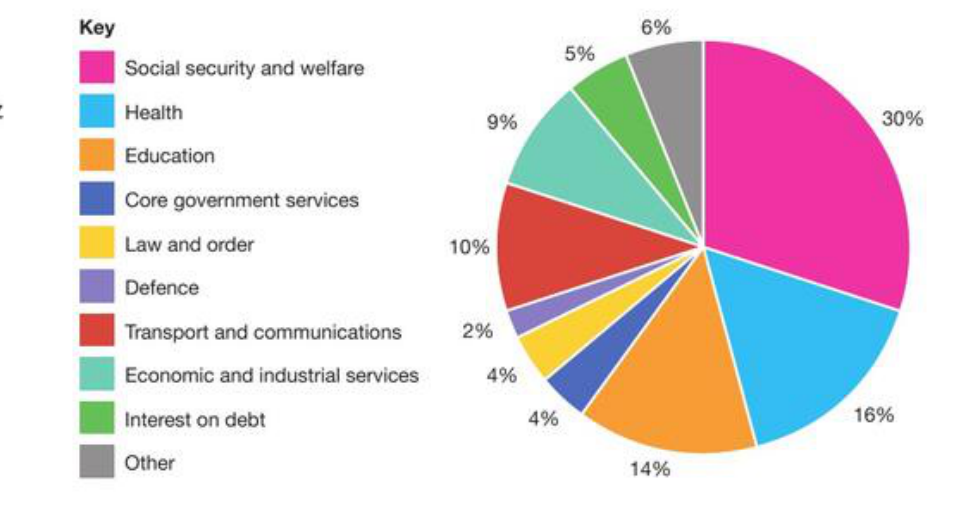
Figure 12.2 divides New Zealand government expenditure in 2015. Social security and welfare accounted for 30%, health 16%, and education 14%. Together these three sectors accounted for 60% of the charted spending.
Taxation
Taxes raise money for public services and can be changed to influence spending, investment and business activity. This is part of fiscal policy, which uses government spending and taxation to help manage the economy.
| Tax | How it works | Possible effect on a business |
|---|---|---|
| Income tax | A direct tax on personal income | Lower income taxes may increase disposable income and consumer purchases. |
| Corporation tax | A direct tax on company profits | A lower rate may leave firms with more profit to reinvest and may attract foreign businesses. |
| VAT | An indirect tax charged on spending on goods and services | Higher VAT can increase prices paid by consumers and may reduce demand. |
In general, the textbook argues that high taxes can reduce demand and may discourage work or investment, whereas lower taxes can encourage spending. However, taxes also help fund the services that businesses and their employees use. The final effect depends on which tax changes and how the money is spent.
The book refers to President Rodrigo Duterte’s historical promise to cut income taxes for low earners in the Philippines, and to reductions in corporation tax in several countries seeking to attract foreign investment. These examples illustrate possible policies, not current tax rates.
Constraints on Public Spending
Governments may try to constrain public spending when borrowing and accumulated debts are high. The textbook discusses cuts following the global financial crisis of 2008. Lower spending can affect private businesses as well as public services.
- Public sector wages and jobs: fewer employees or lower wages mean less income available for spending at shops and other businesses.
- Public contracts: construction, maintenance and other suppliers may lose orders when infrastructure programmes are cancelled or delayed.
- Benefits and pensions: lower payments can reduce disposable incomes and demand for goods and services.
- Industry-specific effects: firms supplying defence equipment or other publicly funded activities may suffer when budgets are cut.
The chapter describes Greece’s difficulties after 2008, debt and public spending cuts. Its examples include cuts to public sector pay, pensions and social security. A private fitness centre in Athens could lose members if households have less disposable income. All figures are historical textbook examples.
Balance of effects: spending cuts may reduce government borrowing, but businesses relying on public contracts or household spending may face lower revenue in the short term.
Check your understanding · Halfway
Try each question first, then reveal its suggested answer.
Give three public services financed by government spending.
Show suggested answer
Examples include health care, education, policing, transport networks and defence.
According to the textbook chart, what combined share of New Zealand government spending went on welfare, health and education in 2015?
Show suggested answer
30% + 16% + 14% = 60%.
Explain the difference between a direct tax and an indirect tax.
Show suggested answer
A direct tax is charged on income or profits, such as income tax or corporation tax. An indirect tax is charged on spending, such as VAT.
What is fiscal policy?
Show suggested answer
Using changes in government expenditure and taxation to help manage the economy.
Give two reasons public spending cuts could reduce revenue at a private fitness centre in Greece.
Show suggested answer
Public sector job or wage cuts and lower benefits may leave households with less disposable income, so some members cancel memberships or spend less.
Explain how a new road-building programme might benefit private businesses.
Show suggested answer
Construction firms can gain contracts; suppliers may receive orders; and workers may spend earnings locally, increasing demand for other firms.
How Can Governments Affect Business Activity?
The textbook identifies four broad ways governments influence businesses: changing the law, influencing interest and exchange rates, changing expenditure and taxation, and using direct measures such as subsidies. It then explains three main approaches: infrastructure, legislation and trade policy.
Infrastructure Provision
Government investment in schools, hospitals, roads, bridges, dams, railways and power supplies supports private firms. Building work creates contracts for construction businesses and orders for their suppliers. Wages paid to workers may also create extra spending throughout the economy.
The chapter describes Uganda’s announced 10-year infrastructure programme in 2015, including improved transport links and electricity generating capacity. Better transport and electricity could benefit agriculture, manufacturing and trade, while contractors could receive new work.
Legislation
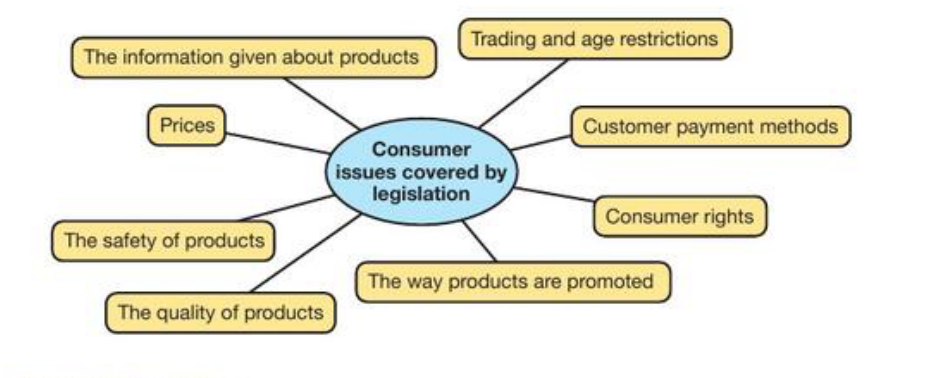
A legal framework can stop firms exploiting consumers, competing unfairly or damaging the environment. Compliance may increase costs for businesses but can also protect customers and fair competition. The chapter explains three particular areas.
Consumer Protection
Consumer laws aim to ensure that products are safe and of satisfactory quality, descriptions are accurate, and claims about products are truthful. The book gives UK consumer-law examples such as the historical Sale of Goods Act 1979 and Food Safety Act 1990. Rules and legal protections vary by jurisdiction and date; these are textbook illustrations.
- Consumers may be protected against unsafe, faulty or misdescribed goods.
- Businesses should avoid false claims, unfair pricing practices and selling goods unfit for their intended purpose.
- Breaking consumer rules can result in fines, compensation claims or other legal consequences.
Competition Policy
Competition policy helps prevent businesses from abusing market power or harming consumers. Governments may encourage small businesses, lower barriers to entering markets, and use laws or agencies to investigate price-fixing, restrictive practices, mergers and takeovers. This can provide consumers with more choice and more competitive prices.
Environmental Legislation
Business activity can produce water pollution, harmful gases, waste or excessive packaging. Governments may pass laws to limit damage to the environment, including controls on waste disposal, emissions and resource use. Businesses may need to invest in cleaner equipment and packaging; firms that fail to comply can face penalties or closure until problems are addressed.
Trade Policy
Governments may protect domestic producers through protectionism. The textbook gives reasons such as protecting jobs, helping infant industries, preventing dumping, and collecting revenue from tariffs.
| Measure | Meaning | Likely business effect |
|---|---|---|
| Tariff | A tax on imported goods | Can raise the domestic price of imports and help local competitors. |
| Quota | A limit on the quantity imported | Restricts the supply of foreign products. |
| Subsidy | Financial support to domestic producers | Can reduce a local firm’s costs. |
| Administrative barriers | Rules, checks or requirements on imports | Can make overseas trading slower or more expensive. |
A trade bloc is a group of countries that cooperate to reduce or remove trade barriers between members. Firms may gain wider markets, opportunities for specialisation and economies of scale, although trade blocs can disadvantage outsiders or create tensions between members.
Effects of Interest Rates on Businesses
Interest is the cost of borrowing money and the return paid to savers. Changes in interest rates influence business spending and consumers’ willingness to borrow. The textbook calls the use of interest rates and the money supply to manage the economy monetary policy.
- Cost of existing borrowing: higher rates may increase interest payments on loans, mortgages and overdrafts, reducing profit and money available for investment.
- New investment: borrowing to buy machinery, equipment or fund research becomes more expensive when rates rise, so some projects may be delayed.
- Customer demand: higher rates may reduce consumer spending, particularly on expensive goods commonly bought using credit, such as cars or homes.
- Lower rates: borrowing is generally cheaper, potentially encouraging investment, expansion and employment.
A business pays simple annual interest on a £100,000 variable-rate loan. At 4%, the annual interest is £4,000; at 7% it is £7,000. This £3,000 increase raises costs, assuming the full principal remains outstanding and no other charges apply.
Businesses with heavy debts are usually more vulnerable to interest rate rises. Those financed mainly from retained profits may be less directly affected, although customer demand can still change.
Effects of Interest Rates on Consumer Spending
Changes in borrowing costs and savings returns can alter disposable income and household spending. This matters because consumer demand provides revenue for many businesses.
- Mortgages: when mortgage payments rise, some homeowners have less money to spend on other goods and services. The effect depends on whether the mortgage rate changes.
- Credit purchases: loans and credit-card borrowing become costlier when rates rise, discouraging purchases of cars, furniture, holidays and other products.
- Savers: when rates are low, savers generally receive less interest income and may have less to spend. Higher rates may benefit savers but hurt borrowers.
- Different business impacts: homebuilding and businesses selling credit-financed products may be particularly sensitive to interest-rate changes.
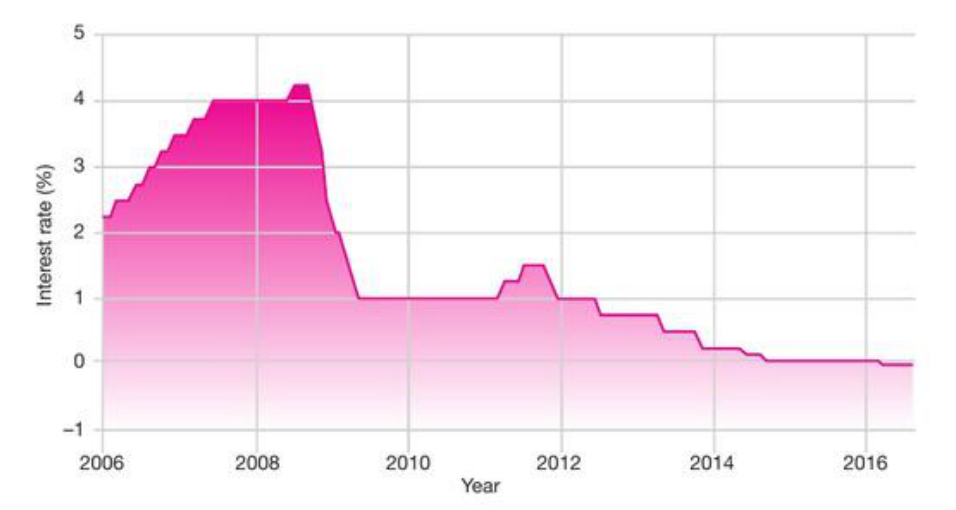
Figure 12.5 shows the interest-rate measure plotted by the textbook rising above 4% in 2008, then falling sharply and remaining near zero around 2015–2016. The historical chart illustrates why businesses monitor policy changes; it is not a current interest-rate quotation.
Overall: higher interest rates tend to reduce borrowing and spending, but the effects differ among borrowers, savers and businesses; not every consumer loses.
Large vs Small Businesses
Both large and small businesses are affected by government spending, taxation, regulation and interest rates. The size and nature of their operations determine how strongly each policy affects them.
| Large businesses | Small businesses |
|---|---|
| May have specialised teams to respond to new regulations. | May face relatively high compliance costs and have fewer specialist staff. |
| Often operate across locations and can be affected by different laws. | Often depend heavily on local customers and local public spending. |
| Some large contractors rely on government infrastructure projects. | A small subcontractor or shop can also benefit from public projects, but a cancellation may be harder to absorb. |
| May have access to multiple sources of finance. | May rely more heavily on bank borrowing or overdrafts. |
Textbook judgement: large firms might feel the impact more from changes to large government projects, while some new laws apply only to businesses above a certain size. Interest rate changes can affect businesses of any size. Specific impacts depend on financing, customers and contracts.
End-of-chapter questions
Try each question first, then reveal its suggested answer.
Explain two reasons governments spend money on public services.
Show suggested answer
They provide essential services such as health care and education and maintain infrastructure that supports households and business activity.
How could a cut in income tax affect consumer demand?
Show suggested answer
Consumers may keep more disposable income and increase spending, raising demand for some businesses.
Why might a reduction in corporation tax encourage investment?
Show suggested answer
A lower tax on profits may leave firms with more retained profit to invest and could attract businesses from overseas.
Describe two ways a government can constrain public spending.
Show suggested answer
It could reduce public sector wages or jobs, cancel construction contracts, or reduce pensions and social security payments.
Explain how consumer protection legislation can benefit buyers and impose costs on firms.
Show suggested answer
Buyers receive safer, correctly described goods and stronger rights. Firms may need to spend on safety checks, quality controls, accurate information and compliance.
What are barriers to entry, and why might lowering them increase competition?
Show suggested answer
They are obstacles faced by new firms joining a market. Reducing them makes entry easier, adding competitors and potentially lowering prices.
Explain one reason a government might impose a tariff and one possible disadvantage.
Show suggested answer
A tariff can protect domestic jobs or infant industries by making imports more expensive, but consumers may face higher prices and less choice.
A business has a £100,000 variable-rate loan. Calculate annual interest at 4% and 7%, and the increase.
Show suggested answer
At 4%, interest is £4,000; at 7%, £7,000; annual interest increases by £3,000, assuming a full year and unchanged principal.
Why could higher interest rates reduce demand for new cars and furniture?
Show suggested answer
These are often purchased with loans or credit. Higher borrowing costs discourage purchases, and higher mortgage payments can reduce disposable income.
Explain why a rise in interest rates does not affect all consumers in the same way.
Show suggested answer
Borrowers with variable-rate debts may pay more, while savers may receive higher interest income; consumers without debt could be less directly affected.
Evaluate whether lower interest rates are always beneficial for small businesses.
Show suggested answer
Lower rates can reduce loan costs and support demand, but small firms with savings may earn less interest, and demand may remain weak for other reasons. The overall effect depends on the firm’s finance and customers.
Chapter 12 recap
Governments influence firms through public spending, taxation, regulations, trade policy and interest rates. Increased spending may create demand and improve infrastructure, while spending cuts can reduce private-sector orders. Consumer and environmental rules protect stakeholders, but bring compliance obligations. Higher interest rates tend to raise borrowing costs and reduce some spending; the impact differs across businesses and households.
Based on Chapter 12, Government Objectives and Policies (printed pp. 88–97) of the user-supplied Pearson Edexcel International GCSE (9–1) Business Student Book by Rob Jones (Pearson). Notes and self-check questions are original adaptations; historical dates, company examples, legal references and charts are drawn from the supplied textbook, not current policy advice. IGCSE360 is not affiliated with Pearson.