
Chapter 13 · External Factors
Understand how social, technological, environmental and political change can create business opportunities and threats.
Learning objectives
- Understand the nature of external factors and why they matter.
- Explain how social, technological, environmental and political factors influence business decisions.
- Assess the different impacts on large and small businesses.
The Nature of External Factors
An external factor is something outside a business that may influence its decisions and performance. Managers cannot normally control these changes, so they must monitor what is happening, respond when necessary and sometimes revise their business plans. An external change can be an opportunity for one firm but a threat to another.
For example, the textbook explains that world oil prices fell by more than 50% during 2014. Businesses selling oil faced falling revenue and reduced exploration; transport firms such as delivery contractors benefited from lower fuel costs. This shows why the same event may have opposite effects across industries.
- Social: changes in attitudes, lifestyles, population and employment patterns.
- Technological: innovations in production, communication, selling and administration.
- Environmental: the effects of business on climate, habitats and scarce resources.
- Political: instability, elections, government changes, national security and pressure groups.
Social networks enable companies to observe preferences, communicate with customers, target advertising, build brand awareness and monitor responses. The textbook refers to Facebook, Twitter, YouTube and Instagram as examples of social-media platforms and uses historical 2016 usage statistics.
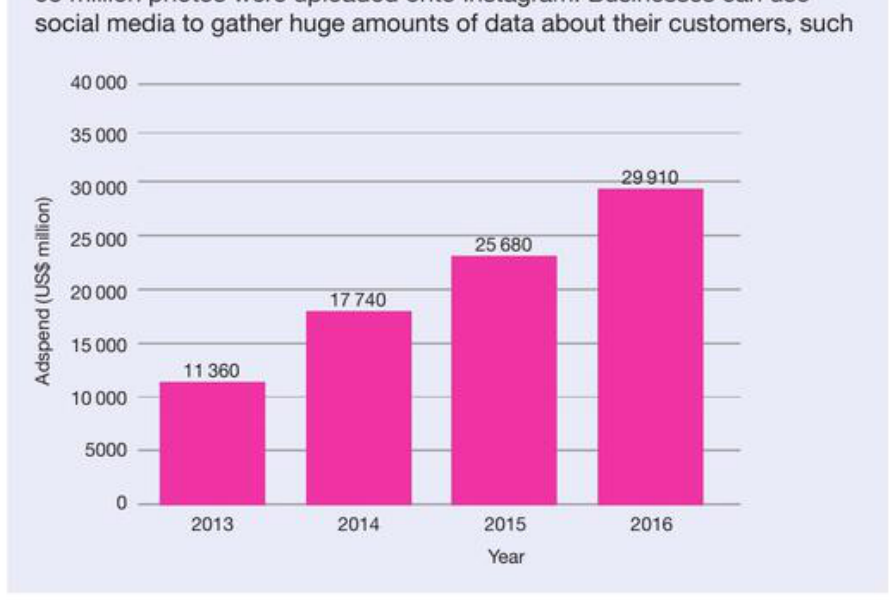
In Figure 13.1, global spending increased from US$11,360 million in 2013 to US$29,910 million in 2016. These are figures from the historical textbook example, not today’s advertising market.
Technology
New technology can create entirely new goods and services and make existing operations faster or cheaper. The textbook notes that production may become more capital-intensive: firms use a greater proportion of equipment and machinery relative to labour. However, technology may require costly investment and training.
- Primary sector: tractors, harvesters, automated feeding systems and chemicals can raise yields and reduce some costs.
- Secondary sector: robots and computer numerically controlled (CNC) machines perform cutting, welding and other repetitive operations, sometimes operating 24 hours a day.
- Tertiary sector: self-service check-in, automated administration, online banking and online retail can increase convenience and reduce some labour or premises costs.
- Management and communication: computers store and analyse data while electronic communication connects employees, customers and suppliers rapidly.
Effects of Technological Change
Technology may shorten the time needed to design, develop and bring a product to market. Firms can automate processes, lower unit costs, and communicate with customers through social media. Nevertheless, adoption may lead to job losses or changes in required skills; equipment, security and maintenance create additional costs.
Possible advantages
- Higher productivity and consistent quality.
- Lower unit costs at sufficient output.
- Faster product development and communication.
- New products and wider customer reach.
Possible disadvantages
- High purchase and installation costs.
- Training and possible worker displacement.
- Obsolescence as technology changes.
- Risk if systems fail or are insecure.
The book describes how three-dimensional printing builds physical objects in layers from digital designs. It can speed prototype production and create customised models, accessories and components. The case also highlights limitations such as printer cost, slower production and material restrictions at the time of publication. The book’s market forecasts are historical, not current predictions.
A firm making prototypes must compare the flexibility of 3D printing with the price, speed, materials and quality available from conventional manufacturing. The best technology depends on the product and scale of production.
Check your understanding · Halfway
Answer first, then expand to compare your response with the suggested answer.
What is an external factor? Give one example.
Show suggested answer
It is a change or influence outside a business that can affect its decisions or performance. Examples include new technology, changing customer lifestyles, environmental concerns and political instability.
Explain why a fall in oil prices can help one business but harm another.
Show suggested answer
A delivery company may pay less for fuel, lowering costs. An oil producer may receive less revenue for its output and reduce investment.
Name two social changes described in the textbook and explain their effect.
Show suggested answer
For example, greater consumer awareness increases pressure for quality and service; more part-time workers may let retailers staff busy periods more flexibly.
Explain what capital-intensive production means.
Show suggested answer
It is production that uses relatively more machinery and equipment compared with labour, for example robot-controlled factory operations.
What could a manufacturer gain from adopting computer-controlled equipment?
Show suggested answer
Potential benefits include lower unit costs, consistent product quality, faster output and operation over longer hours, provided investment costs are justified.
Using Figure 13.1, calculate the percentage increase in social-media advertising spend from US$11,360m in 2013 to US$29,910m in 2016.
Show suggested answer
(29,910 − 11,360) ÷ 11,360 × 100 ≈ 163.3%. The figures are historical textbook data.
Environment
Environmental factors involve the effects of business activity on the natural world, including emissions, pollution and the use of scarce resources. As economies expand, firms may face criticism over environmental damage. They may also see opportunities to introduce cleaner products and more efficient production.
Global Warming
The textbook links greenhouse-gas emissions—such as carbon dioxide from factories, road vehicles and aircraft—with changes to the Earth’s climate. Businesses may face pressure to reduce emissions and energy use, while demand for lower-emission alternatives can create new markets.
Habitat Destruction
Business development can destroy wildlife habitats and reduce biodiversity, for example when forests are cleared for buildings, agriculture or industrial use. Environmental safeguards, sustainable sourcing and careful site selection can reduce harmful effects.
Resource Depletion
Some resources are finite or used faster than they can be replaced. The textbook highlights oil, coal, gas, minerals, fish stocks and fertile soil. Businesses dependent on such inputs may face rising costs or disrupted supply. Managing waste and using inputs more efficiently can help.
Sustainable Development
Sustainable development means meeting current needs without compromising the ability of future generations to meet theirs. Businesses can support this through recycling, reusable packaging, energy-efficient equipment, renewable energy, reducing waste and unnecessary travel. These practices may improve public image, support regulatory compliance and sometimes reduce costs, although changing equipment can require investment.
The book discusses Volkswagen, Hyundai-Kia, Ford and the Nissan Leaf as historical examples of vehicle makers responding to environmental concerns, government encouragement and fuel prices. Electric vehicles offered opportunities, while changing oil prices affected their relative running-cost appeal. The dates and figures in the case relate to the textbook period.
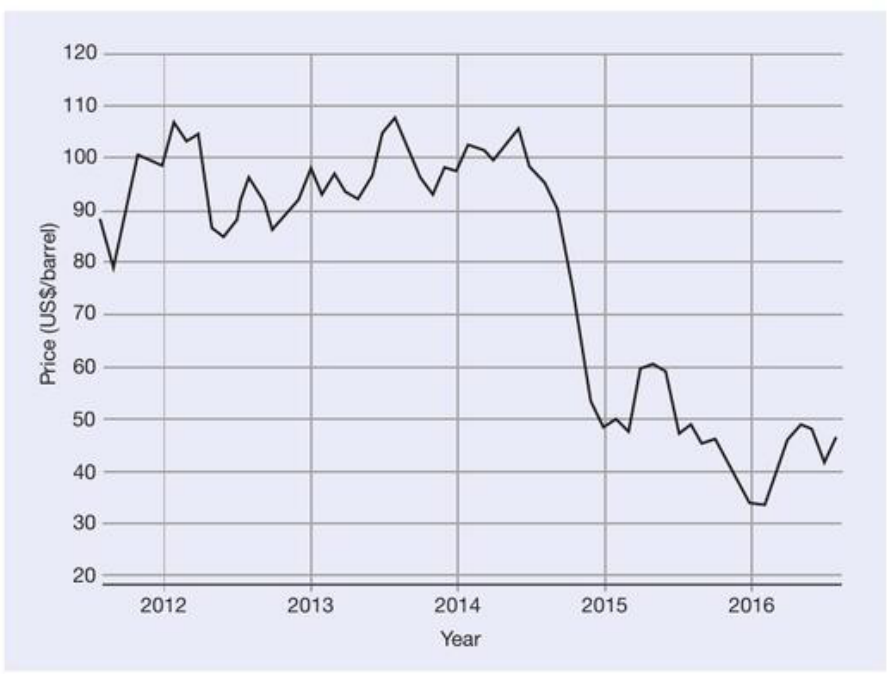
Figure 13.2 illustrates a sharp decline in oil prices after 2014. Lower petrol costs could make conventional vehicles more attractive to some consumers, potentially slowing demand for electric vehicles. By contrast, concerns about emissions and environmental protection could still support electric-vehicle development.
Political
Political conditions influence business confidence, decisions and costs. Firms may need to respond to elections, government policy changes, uncertainty, pressure groups and national-security measures. Some countries provide a stable setting for investment, while others experience more political disruption.
- Political instability: conflict and uncertainty can discourage investment, interrupt production or create risks for staff.
- International relationships: trade agreements and changes to country relationships can affect tariffs, exchange rates and access to markets.
- National security: travel restrictions or border controls may make it harder for workers and goods to move.
- Pressure groups: organised campaigns can influence customer opinions and encourage firms or governments to change their behaviour.
- Elections and government priorities: a new administration may bring policies perceived as more or less favourable to entrepreneurs and investors.
The book uses the UK’s June 2016 vote to leave the European Union as an example of political uncertainty. It notes that sterling fell against many currencies immediately after the result. This is a description of an historical event, not a forecast of later developments.
The textbook cites Action on Smoking and Health (ASH) as an example of a pressure group campaigning to reduce smoking. Public campaigns can influence demand and the reputation or marketing practices of firms linked to the affected industry.
Businesses cannot choose election outcomes or eliminate political uncertainty. However, they can follow developments, assess risks and make contingency plans, such as preparing alternative suppliers or markets.
Large vs Small Businesses
External factors affect businesses of every size, but their ability to respond may differ. The textbook points out that the unexpected 2014 oil-price fall could benefit organisations ranging from sole-trader taxi drivers to large manufacturers using oil-based raw materials. Larger companies may be better placed to prepare detailed contingency plans because they have more finance, staff and alternative resources.
Large businesses
- Can employ specialists to monitor external factors.
- Often have finance for research, investment and contingency planning.
- May spread risks across several products or locations.
- Can still be badly affected if a major market or supply chain is disrupted.
Small businesses
- Can sometimes respond quickly to local customer trends.
- May benefit from social media and inexpensive digital tools.
- Often have fewer financial reserves if costs rise unexpectedly.
- May depend heavily on one market, supplier or product.
The chapter review describes Rohan Gupta establishing Attero Recycling in India to collect and process electronic waste, including used computers, phones and office equipment. The case illustrates how environmental concerns can inspire a business opportunity. The historical figures in the book should not be read as current company statistics.
Overall judgement: the effects of an external factor depend on the business’s industry, financial resources, customer base and ability to adapt. Large firms may have stronger reserves, while a small firm may adjust its offering faster.
End-of-chapter questions
Answer first, then expand to compare your response with the suggested answer.
Identify the four main categories of external factors covered in this chapter.
Show suggested answer
Social, technological, environmental and political factors.
Explain two ways urbanisation can influence a business.
Show suggested answer
It may provide more potential urban customers and a larger supply of workers. It may also create higher rents, traffic congestion or tougher competition.
How might changing lifestyles increase demand for takeaway meals and home delivery?
Show suggested answer
Busier schedules can make convenience more important, so customers may prefer prepared meals and services delivered to their homes.
Describe one benefit and one cost of using robots on a production line.
Show suggested answer
A robot may raise productivity or lower unit costs, but buying, maintaining and programming it may be expensive and workers may need retraining.
Explain how 3D printing may improve product development.
Show suggested answer
A 3D printer can turn a digital design into a prototype, allowing a firm to test and refine a model more quickly without waiting for traditional tooling.
Distinguish between habitat destruction and resource depletion.
Show suggested answer
Habitat destruction damages places where living things survive. Resource depletion means reducing stocks of resources such as fuels, minerals, fish or fertile soil.
Explain two actions a business could take to support sustainable development.
Show suggested answer
It could design recyclable packaging and use energy-efficient machinery or renewable energy, reducing waste and resource use.
Using Figure 13.2, describe the main trend in oil prices from 2014 to early 2016.
Show suggested answer
The line shows a steep fall, from around US$100 per barrel in much of 2014 to a level close to US$30–40 in early 2016. These are approximate chart readings.
Why might a pressure-group campaign affect demand for a product?
Show suggested answer
Campaigns can influence public awareness and customer attitudes, encouraging some consumers to avoid or favour products and prompting businesses to change practices.
Analyse how political instability could affect a business considering investment abroad.
Show suggested answer
Uncertainty may increase risks to staff, suppliers and demand. It could deter investment, raise security costs or encourage the firm to choose another location. The severity depends on the country and business.
Evaluate whether large businesses are always better able than small businesses to respond to external change.
Show suggested answer
Large firms often have more money, staff and fallback options, making planning easier. However, small firms may react faster and tailor products to new demand. Effectiveness depends on the change, the sector, resources and management decisions.
Chapter 13 recap
External factors originate outside a business and cannot normally be controlled by its managers. Social change affects demand and the workforce. Technology can raise productivity or require costly investment. Environmental challenges encourage resource conservation and sustainable development. Political change can alter risk and business confidence. A development may help one firm and harm another; response depends on size, industry and resources.
Based on Chapter 13, External Factors (printed pp. 99–107), of the user-supplied Pearson Edexcel International GCSE (9–1) Business Student Book by Rob Jones (Pearson). Notes and questions are original adaptations; dated business cases and charts are historical textbook examples. IGCSE360 is not affiliated with Pearson.
Social
Businesses have to adapt when society changes. Customers may demand different products, expect better service or alter their buying habits. At the same time, shifts in the workforce can affect recruitment, working hours and the number of potential customers.
Increased Consumer Awareness
Consumers can access extensive information about products, prices and customer reviews through the internet. They may expect higher quality, better service and greater transparency. Firms can respond by improving product information, after-sales support and quality. Poor reviews can quickly damage a reputation.
Changing Demand Patterns
Modern lifestyles change what people buy. The textbook notes growing demand for home-delivered food, takeaway meals, personal services and online businesses. A business that spots changes early may win customers; one that ignores them risks losing sales.
Increased Numbers of Women at Work
The textbook describes more women taking paid employment in many countries. This can increase the supply of workers, create demand for childcare and related services, and influence consumer spending. Actual trends vary between countries and over time.
More Part-time Workers
More people working part-time can help firms adapt staffing to busy and quiet periods. For example, a retailer might employ additional staff at weekends. However, managers need to plan shifts and training carefully.
Urbanisation
Urbanisation is the movement or growth of populations into towns and cities, often involving development on formerly rural land. In fast-growing cities, businesses can access larger customer markets and labour pools, but may face higher rents, congestion or stronger competition.
If more people commute into a city and expect quick meals, a café could introduce takeaway breakfast options, online ordering and evening opening. Whether these changes succeed depends on demand, costs and local competition.