
Chapter 38 · Place
Understand how goods reach buyers through retailers, wholesalers, agents, direct selling and e-commerce, and how businesses choose the right distribution channels.
Learning objectives
- Understand the role of distribution channels in marketing.
- Understand the different methods of distribution, including retailing, wholesaling, direct selling and agents.
- Understand the role of e-commerce (e-tailing) in distribution.
What Is Place?
Place is one of the four Ps of the marketing mix. It is concerned with making a good or service available where and when customers want to buy it. Choosing attractive selling locations is important, but place also includes the way products travel from their producers to buyers.
For example, food manufacturers depend on supermarkets and other accessible outlets. Motorway service stations need to be near busy roads; otherwise, even good facilities may attract too few customers.
Example: Unilever
Unilever illustrates the distribution needs of a multinational business. In 2015, it reported about 400 brands and €53,300 million in sales revenue. Its products reached customers through chain stores, supermarkets, independent retailers, wholesalers, co-operatives, agents and distributors, supported by distribution centres and warehouses.
A widely consumed product, such as a household cleaning product, needs extensive availability. Relying on only a few specialist shops could reduce sales even if the product is well known.
Distribution Channels
Some products are sold directly from producers to customers. Other channels involve intermediaries, such as retailers, wholesalers and agents, who help move goods and arrange sales. A producer may use several channels at once.
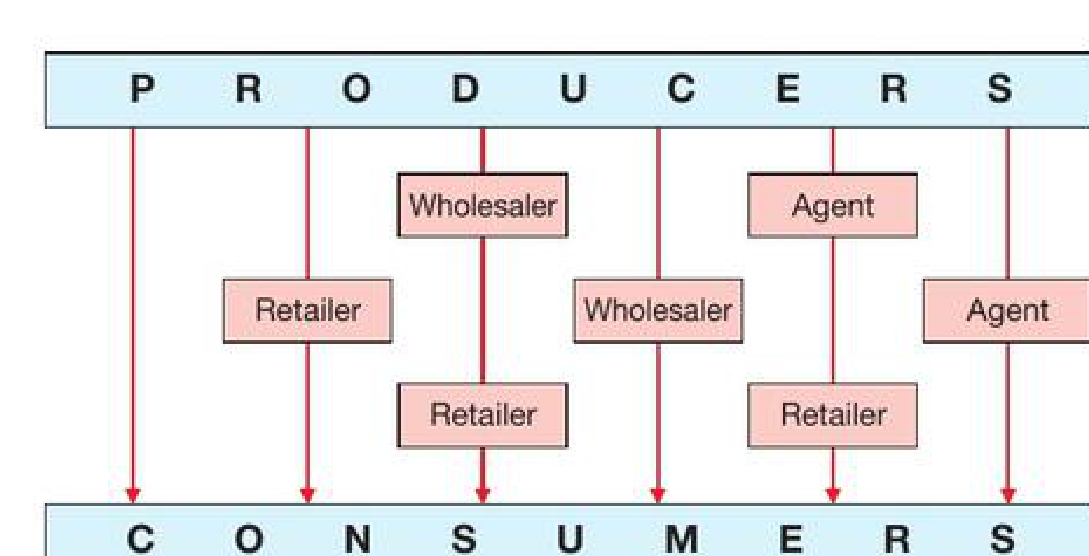
| Channel | Route | Example or reason to use |
|---|---|---|
| Direct | Producer → Consumer | A local bakery selling to people in its own shop; closer contact with buyers. |
| Via retailer | Producer → Retailer → Consumer | Goods are stocked in shops near customers. |
| Via wholesaler | Producer → Wholesaler → Retailer → Consumer | Large quantities are divided for smaller shops. |
| Via agent | Producer → Agent → Retailer or Consumer | An intermediary introduces a producer to buyers or other sellers. |
Intermediary means a person or organisation helping producers reach buyers. It can make distribution more convenient, although intermediaries may add costs or reduce the producer’s direct control.
Retailing
Services Provided by Retailers
- Bulk-breaking: buying large amounts and selling them to buyers in smaller, convenient quantities.
- Convenience: placing goods where customers can reach them, often with parking or public transport.
- Additional value: offering packaging, delivery, product information, repairs, guarantees and gift wrapping.
Different businesses use several retail outlet types. Each suits a different combination of target customers, operating costs, product range and service requirements.
Independents
Often relatively small, individually owned outlets such as local grocers, newsagents, delicatessens and specialist bicycle or jewellery shops. They may offer personal service or specialist knowledge but lack the purchasing economies of big chains.
Supermarkets
Supermarkets offer groceries and everyday goods in a single location; larger ones may stock thousands of product lines. Bulk purchasing can lower prices, while convenient parking and one-stop shopping attract customers.
Department Stores
Department stores divide their floor space into categories such as cosmetics, clothing, gifts and household goods. They offer broad ranges, specialist staff and customer service; Harrods in London is an example.
Multiples or Chain Stores
A chain store is one of several outlets owned and controlled by the same business, commonly using standardised products, prices, shop fronts, layouts and staff policies. Central purchasing may lower costs, but individual stores can be less flexible.
Superstores or Hypermarkets
Very large, usually out-of-town stores selling many types of products. Their large scale may allow lower prices and wider ranges, but they may have less staff assistance and be less convenient for customers without transport.
Kiosks and Street Vendors
Small selling points with limited product ranges, found in streets, airports, rail stations or cinemas. Their set-up costs can be modest, although busy locations can have expensive rents.
Market Traders
Small businesses selling from market stalls. They often have lower overheads than large shops and may move between markets, while some sellers in souks occupy permanent stalls.
Online Retailers
Businesses such as Amazon sell goods through digital storefronts. Unlike a traditional shop, an online retailer can accept orders at any hour, but must organise payments, delivery, returns and customer service.
| Retailer | Typical advantage | Possible drawback |
|---|---|---|
| Independent | Personal attention and specialisation | Often higher unit costs |
| Supermarket | Bulk purchasing and one-stop shopping | Limited specialist assistance |
| Department store | Separate departments and knowledgeable service | Higher service and premises costs |
| Chain store | Recognisable brand and standardisation | Less local flexibility |
| Hypermarket | Wide selection and competitive prices | May require travel |
| Market stall or kiosk | Lower overheads or convenient selling point | Restricted range or space |
E-tailing (E-commerce)
Business to Consumers (B2C)
B2C means selling goods or services from a business to individual customers. Customers can order online for home delivery or select click and collect, where an order is collected from a store or pick-up point. Revision examples include travel tickets, holidays, films, auction sites, banking and insurance.
Business to Business (B2B)
B2B means one business selling to another. For example, a manufacturer may order components or supplies from a specialist business-to-business website. Digital purchasing systems can help find suppliers, compare prices and reduce paperwork.
Benefits and Limitations of Online Distribution
- For customers: potentially lower prices, a wide range of products, 24/7 shopping and access from different locations.
- For businesses: potentially lower premises and start-up costs, automated processing, less paperwork, a wider geographical market and round-the-clock access.
- Limitations: global competition, cybersecurity risks, technical failures, weak human contact, dependence on delivery firms and limited opportunities to inspect goods before buying.
Online selling may allow a small producer to reach international customers. However, packaging, returns, delivery charges and online advertising could increase costs, so a website does not automatically make a business more profitable.
Check your understanding · Halfway
Try each question independently, then select Show suggested answer to check your reasoning.
Define place in the marketing mix. Explain why being in the correct location can matter to a business.
Show suggested answer
Place refers to where and how customers can obtain products. Customers may not buy a product if it is difficult to reach or not available when required.
Explain the meaning of a distribution channel and name two possible intermediaries.
Show suggested answer
A distribution channel is the route a product takes from producer to consumer. Two possible intermediaries are retailers, wholesalers or agents.
A small shop buys a box of 100 chocolate bars and sells individual bars. Which service is it providing?
Show suggested answer
It is providing bulk-breaking: dividing a larger quantity into smaller quantities suitable for consumers.
Describe one difference between an independent shop and a chain store.
Show suggested answer
An independent is generally owned separately and can adapt locally, while chain stores share an owner and usually have standardised products, layouts or policies.
Distinguish between B2C and B2B online selling using one example of each.
Show suggested answer
B2C sells from business to consumer, such as booking a hotel online. B2B sells between businesses, such as a café buying coffee beans from an online supplier.
Discuss one benefit and one limitation of e-tailing for a small retailer.
Show suggested answer
A benefit is reaching customers beyond the local area without opening many physical shops. A limitation is needing reliable delivery and secure payment systems, plus facing intense online competition.
Other Distribution Methods
Direct Selling
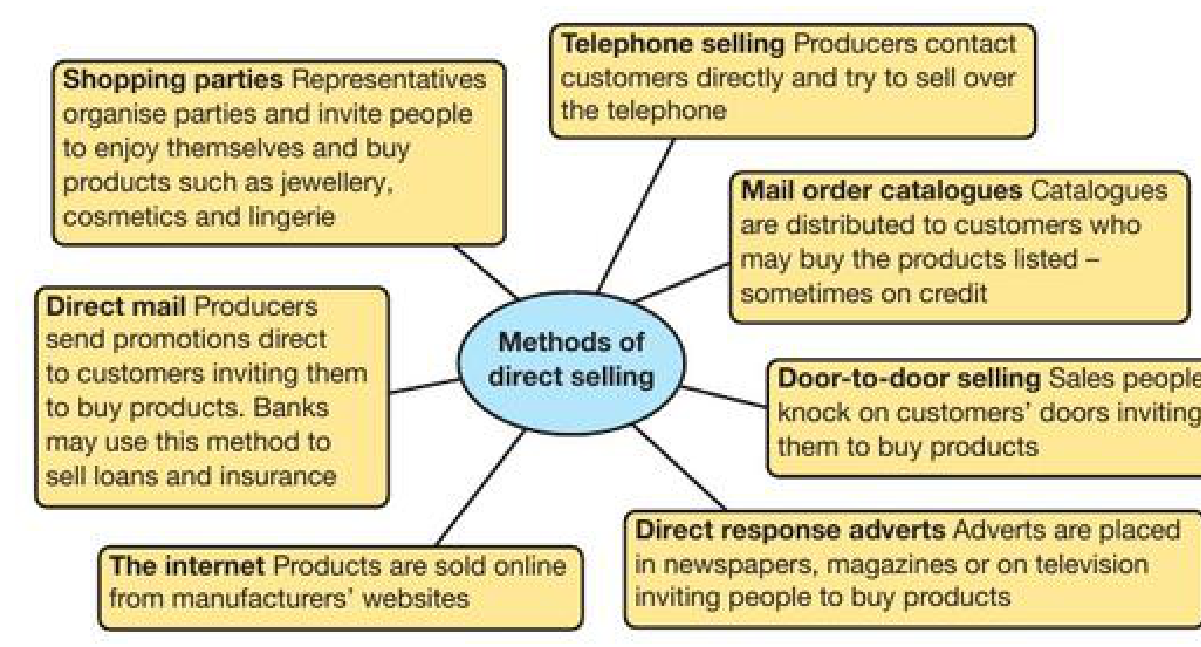
Direct selling can take several forms, including shopping parties, telephone selling, mail-order catalogues, door-to-door selling, direct-response adverts, direct mail and manufacturers’ own websites. Selling directly may improve customer contact and producer control, although the producer takes responsibility for sales and sometimes delivery.
Wholesaling
Wholesalers buy goods from manufacturers and generally resell them to retailers. They may break bulk, store, repackage and deliver goods. Some cash-and-carry wholesalers require buyers to pay immediately and transport their purchases away. Wholesalers can help small independent retailers access goods from many manufacturers.
Agents or Brokers
An agent or broker connects buyers with sellers and helps arrange a sale. Examples include travel agents, estate agents and intermediaries for insurance or mortgage products. When entering an overseas market, a producer may use an agent’s knowledge of local customers and business practices to reduce risk.
Activity 1: Bata
Bata provides an example of a footwear manufacturer using its own stores, wholesalers and independent dealers. Historical figures include 5,000 stores, 26 manufacturing units in 18 countries, approximately 30,000 dealers and sales revenue of Rs 24,813.43 million in 2016. The example shows how different distribution routes can work together.
Selling through its own shops can help a manufacturer control service standards and appearance, while wholesaling through many other dealers extends the number of places where its products can be purchased. Running its own stores also involves rent and staffing costs.
Choosing Appropriate Distribution Channels
The most suitable channel depends on the product, the cost of distributing it, the customers being served and how much control the producer needs. A business should not simply choose the shortest or cheapest channel without considering customer expectations.
The Nature of the Product
Services are often delivered directly. Fast-moving goods such as cereals or crisps usually need widespread retail access and bulk-breaking. Exclusive or high-quality goods may require selected dealers with specialist knowledge and a carefully controlled image. Some goods need demonstration before purchase.
Cost
Each intermediary may charge for its services or require a margin. Direct distribution can reduce intermediary payments, but the producer may need to pay for warehousing, selling, marketing and deliveries itself. Large supermarkets often buy directly from producers, while small independent shops may depend on wholesalers.
The Market
Mass-market goods may benefit from many retailers. Specialist goods and local services may be sold directly. Producers entering overseas markets might prefer agents with local knowledge. Businesses selling to other businesses may use fewer intermediaries.
Control
A producer may want to determine exactly how a product is displayed, explained, priced or serviced. This is especially important for prestigious brands. Using selected outlets can protect the brand image, although it may restrict the number of potential buyers.
Activity 2: Rolex
In a historical example, Rolex used authorised specialist retailers to provide expert advice, check authenticity and maintain a luxury shopping experience. This is an illustration of selective distribution, not a claim about current sales arrangements.
| Factor | Example of its effect on choice |
|---|---|
| Nature of product | An exclusive watch uses selected specialist retailers; everyday groceries need broad availability. |
| Cost | An online direct route avoids some intermediary margins but still has distribution and fulfilment costs. |
| Market | A mass-market brand may use supermarkets; a niche local service may deal directly with customers. |
| Control | Premium brands may restrict outlets to protect presentation and customer experience. |
Large vs Small Businesses
Both large and small businesses need reliable distribution. A very large manufacturer may move huge volumes through warehouses, wholesalers and retailers; a poorly chosen channel can create expensive delays and prevent products reaching customers on time.
Smaller businesses may operate with fewer stores and a narrower distribution network, but e-commerce can make customers in other countries more accessible without opening physical shops there. However, small firms still have to pay for delivery, returns, online payments and promotional activities.
End-of-chapter questions
Try each question independently, then select Show suggested answer to check your reasoning.
Define distribution channel and explain why a manufacturer might use more than one route to consumers.
Show suggested answer
A distribution channel is the path goods take from producer to buyer. Multiple channels can reach different groups, such as supermarkets for everyday shoppers and a business website for direct buyers.
Describe two services that retailers provide to consumers or producers.
Show suggested answer
Retailers perform bulk-breaking, making products convenient to buy in small quantities; they also offer accessible locations, advice, deliveries, repairs or guarantees.
Explain two characteristics of a department store.
Show suggested answer
A department store is divided into product departments and normally offers wide ranges with trained staff and customer service, often in a city-centre location.
Compare wholesaling with retailing.
Show suggested answer
Wholesalers usually buy from producers and sell to other businesses, often retailers, providing storage or bulk-breaking. Retailers sell products to final consumers in quantities suitable for their needs.
Explain one reason a manufacturer like Bata might sell through its own chain stores and one reason it might use other dealers.
Show suggested answer
Own stores improve control over product presentation, customer service and brand image. Other dealers offer greater geographical reach without the manufacturer operating every outlet itself.
Give two advantages and two limitations of B2C e-tailing for customers.
Show suggested answer
Advantages include shopping 24/7 and more choice, possibly at lower prices. Limitations include inability to inspect items before purchase, delivery problems, technical failures, fraud or security risks.
Distinguish direct selling from selling through an agent or broker.
Show suggested answer
Direct selling means the producer sells directly to the customer; an agent or broker instead helps connect the buyer and seller or arranges the transaction, often using specialist or local knowledge.
A retailer reports online sales of US$1,300 million and total sales of US$5,095 million. Calculate the percentage of sales made online.
Show suggested answer
Online sales share = 1,300 ÷ 5,095 × 100 = 25.5% (to one decimal place).
A business increases its online revenue by 13% to US$1,300 million. Estimate the revenue before the increase.
Show suggested answer
Original revenue = 1,300 ÷ 1.13 ≈ US$1,150.4 million. Divide by 1.13 to reverse a 13% increase.
Analyse why a luxury-watch producer might prefer authorised specialist retailers to supermarket distribution.
Show suggested answer
Specialist retailers can offer expert advice, authenticity checks and prestigious presentation, helping protect the brand image. Supermarkets could offer wider reach but less control over customer experience.
Evaluate whether a small business should switch entirely to online distribution.
Show suggested answer
Online sales can reduce shop costs and reach distant buyers, but the decision depends on product suitability, digital access, delivery expenses, returns, trust and the customers’ need for face-to-face advice. A mixed approach may be better than abandoning physical sales altogether.
Chapter 38 recap
Place ensures customers can obtain products in convenient locations and at suitable times. Products may travel directly from producers to customers or through retailers, wholesalers and agents. Physical stores and online selling offer different benefits and risks. The most appropriate channel depends on the nature of the product, cost, market and desired control.